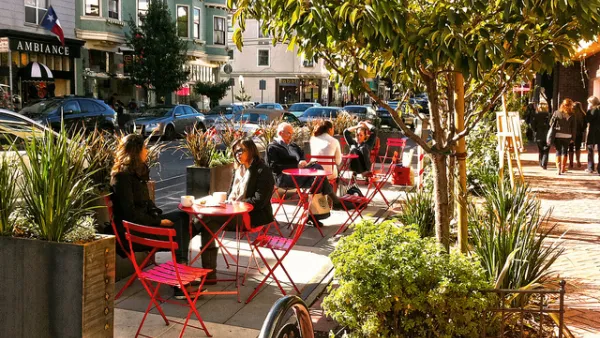
Parking spaces in San Francisco are being repurposed as small patio-like park spaces and out door seating areas. John King of the San Francisco Chronicle looks at how they've become part of the city.


"Some are no more than platforms lined with planters; others have a sculptural look or tie in to the landscaping of the adjacent sidewalk. Some feel genuinely public. Others emphatically do not.
What began last year as a form of ad hoc urbanism is emerging as a distinctive feature of neighborhood commercial districts, particularly on the eastern side of the city. Even the most compromised parklets are of value, if only to show what's at stake as the experiment evolves.
'Every circumstance is different,' said Jane Martin of Shift Design Studio. 'It gets people talking about design and comfort on the street.'"
14 of these parklets have already been built and 12 more should be complete by the end of summer.
Read the full story: S.F. parklets emerge as neighborhood fixtures

San Francisco Supervisors Vote to Keep Parklets, Close Them at Night
The pandemic-era outdoor seating arrangements can stay, but a last-minute amendment lets business owners close them overnight.
More 'Parklets' Heading to San Francisco
The City of San Francisco is expanding its program of "parklets" -- small public patio-like spaces built on parking spots.

‘Grätzloasen’: The Urban Oases Vienna Pays its Citizens to Build
The Austrian capital offers grants of up to 5,000 Euros to residents who want to build their own parklets in curbside parking spaces.

Planetizen Federal Action Tracker
A weekly monitor of how Trump’s orders and actions are impacting planners and planning in America.

Amtrak, CN end decades-long dispute with eight-year agreement
The new operating agreement establishes an updated framework for the companies to work together, including processes to resolve disputes.
Nation's most wind-powered state turns to coal as data centers increase energy demand
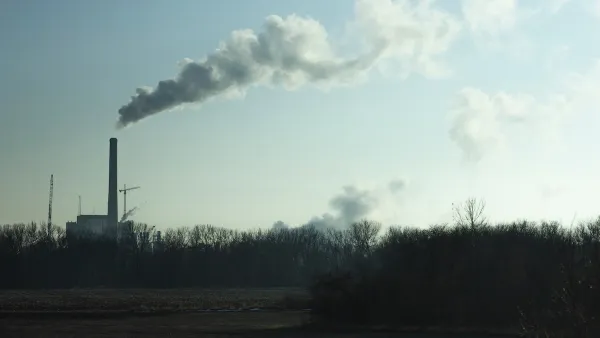
For the first time in decades, Iowa has increased its generation of coal power.

Alabama scores up to $2.5 billion federal loan for largest infrastructure project in state’s history
The Mobile River Bridge and Bayway Project aims to ease congestion at Alabama’s worst bottleneck.

Trump is considering data centers on 6 states' public land — some state officials say they had no idea
If the administration approves the proposed projects, data center and data center-related developments will cover 17,600 acres of public land.

Despite court ruling, Trump is keeping nearly all wind projects in the US on hold
At least 110 wind energy projects have not heard from the government since a federal judge ruled that the Trump administration's freeze on wind turbine clearances was likely illegal.

FREE Course: Walkable City 1: Why Walkability?
After describing his path towards focusing on walkability as the essence of good planning, Jeff Speck marches through his five principal reasons for making more walkable places.
Reinventing Malls: Planning Alchemy—Turning Gray Fields Into Gold
The course focuses on the opportunities and imperatives that shape reinvention of mall sites.

KFH Group Inc.
Greater Baltimore Committee
Eagle County Government
The Architects Foundation
University of Cincinnati Online
The Pocatello Development Authority
The Urban Renewal Agency of the City of Pocatello