The center of protest in Yemen's capital city of Sana'a has turned into a massive tent city, with more than 4,000 tents and a variety of services, public spaces and pop-up industries.


"What started as a sit-in has turned into an experment in democratic society. In the last four months, between 3,000 and 4,000 tents have been pitched in the streets of the university district in the Yemeni capital Sana'a. The tent city includes pharmacies and a makeshift hospital, four daily newspapers, auditoriums, a garden and hastily constructed cement memorials for the martyrs.
It is a city of citizens, a taste of what Yemen could become, a concrete utopia made of tarps, pallets, satellite dishes and a hodgepodge of power cables the protesters have audaciously connected to the grid in the ancient city. There is a "diplomats' tent" and a tent for actors; there are daily poetry readings and demonstrations; there is even a prison."
The tent city has been up for almost five months, and even has designated streets and street names.
Read the full story: The Tent-Dwellers of Sana'a

Reclaiming Transportation as a Place of Resistance
The systems that move us are not neutral — and we don’t have to pretend like they are.
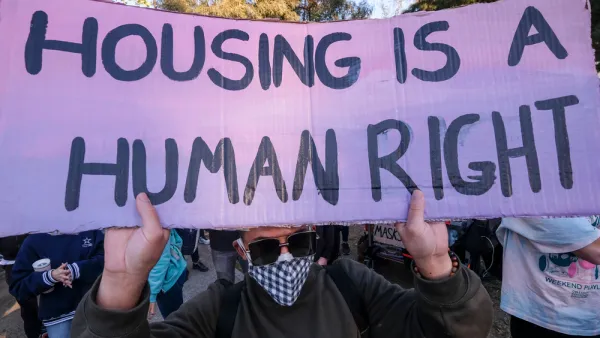
Photos: In Over a Dozen Cities, Housing Activists Connect HUD Cuts and Local Issues
We share images from six of the cities around the country where members of three national organizing networks took action on May 20 to protest cuts to federal housing funding and lift up local solutions.
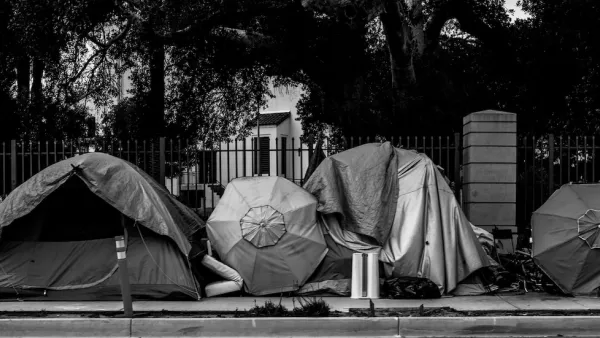
Trump Wants to Force Homeless People Into ‘Tent Cities.’ Can He?
The president pushed for sweeping crackdowns and the possible internment of people experiencing homelessness. To see what's coming, we should look to what states have already done.

Planetizen Federal Action Tracker
A weekly monitor of how Trump’s orders and actions are impacting planners and planning in America.

Chicago breaks ground on $3 billion megadevelopment
The new neighborhood, titled Foundry Park, will one day host 3,700 residences.

This MA town is drowning in its own sewage — and residents like it that way
Susan Murcott, a waste water expert, said if Carlisle didn't address their leaking sewage, the problem could turn “deadly.”

Amtrak cuts ribbon on Seattle Airo maintenance facility
The $250 million, nearly 100,000-square-foot building can house an entire Cascades Airo trainset.

To power data centers, Google seeks autonomous control of thousands of homes’ electricity
The tech company has signed a deal to indirectly pay Mid-Atlantic residents to reduce their power demand when the grid is strained.

From robotaxis to robotrains: LA, DC weigh driverless transit
If approved, the projects will take years to implement and face financial and technical hurdles.

FREE Course: Walkable City 1: Why Walkability?
After describing his path towards focusing on walkability as the essence of good planning, Jeff Speck marches through his five principal reasons for making more walkable places.
Reinventing Malls: Planning Alchemy—Turning Gray Fields Into Gold
The course focuses on the opportunities and imperatives that shape reinvention of mall sites.

City of Rosemead
Rutgers University, Edward J. Bloustein School of Planning and Public Policy
One Hundred Miles
The Architects Foundation
University of Cincinnati Online
Montrose County
The Pocatello Development Authority
The Urban Renewal Agency of the City of Pocatello