The $250 million, nearly 100,000-square-foot building can house an entire Cascades Airo trainset.



Amtrak cut the ribbon on its $250 million Seattle maintenance facility on Oct. 23. The rail company designed the facility for its Airo trainsets, which carry passengers on the Amtrak Cascades route, and finished it on time and $50 million below budget.
“The building covers nearly 100,000 square feet and is about 700 feet long, enough to hold a complete Cascades Airo trainset. Inside, three tracks let crews inspect, service and carry out heavy maintenance on a whole trainset in one place. Amtrak describes it as its first maintenance facility of this kind,” Oleksandr Batrak writes for Railway Supply.
The Seattle facility is the first of six maintenance buildings that Amtrak is upgrading for the Airo fleet. Laura Mason, Amtrak’s executive vice president of capital delivery, said that the ability to maintain an entire Airo trainset at once in the larger facilities would make repairs more efficient.
Read the full story: First of Amtrak’s six major Airo maintenance facilities opens in Seattle

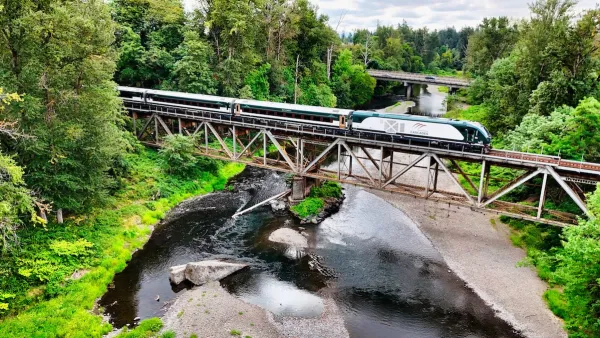
Airo trainsets begin service on Amtrak Cascades route
The trains feature panoramic windows, complementary wifi and over 300 seats per train set.
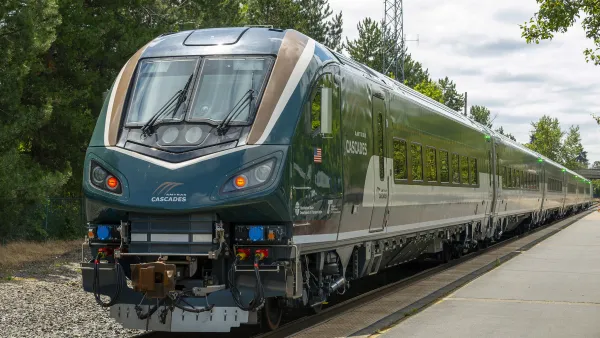
Northwest rail fans eager for Sept. 30 debut of Amtrak’s Airo fleet
Get ready for that new train smell and more seats. But they won’t go faster or run more frequently on the Cascades route in Washington and Oregon.
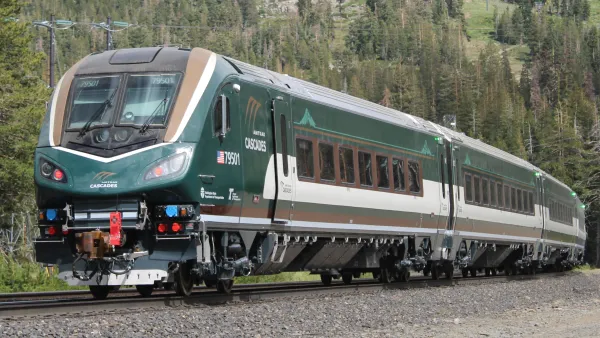
Washington and Oregon receive first new Amtrak trains in decades
The Airo trains promise shorter commutes, more frequent trips and fewer emissions than their predecessors.

Planetizen Federal Action Tracker
A weekly monitor of how Trump’s orders and actions are impacting planners and planning in America.

Chicago breaks ground on $3 billion megadevelopment
The new neighborhood, titled Foundry Park, will one day host 3,700 residences.

This MA town is drowning in its own sewage — and residents like it that way
Susan Murcott, a waste water expert, said if Carlisle didn't address their leaking sewage, the problem could turn “deadly.”

Amtrak cuts ribbon on Seattle Airo maintenance facility
The $250 million, nearly 100,000-square-foot building can house an entire Cascades Airo trainset.

To power data centers, Google seeks autonomous control of thousands of homes’ electricity
The tech company has signed a deal to indirectly pay Mid-Atlantic residents to reduce their power demand when the grid is strained.

From robotaxis to robotrains: LA, DC weigh driverless transit
If approved, the projects will take years to implement and face financial and technical hurdles.

FREE Course: Walkable City 1: Why Walkability?
After describing his path towards focusing on walkability as the essence of good planning, Jeff Speck marches through his five principal reasons for making more walkable places.
Reinventing Malls: Planning Alchemy—Turning Gray Fields Into Gold
The course focuses on the opportunities and imperatives that shape reinvention of mall sites.

City of Rosemead
Rutgers University, Edward J. Bloustein School of Planning and Public Policy
One Hundred Miles
The Architects Foundation
University of Cincinnati Online
Montrose County
The Pocatello Development Authority
The Urban Renewal Agency of the City of Pocatello