Gas prices have been dropping for a month. According to the chief oil analyst with the Oil Price Information Service in this radio interview, expect prices to continue dropping to as low as $3.25 a gallon, but don't expect lower than $3.00.


On Weekend Edition, June 19, the NPR reporter notes that "the national average for a gallon of regular fuel is now $3.65. That's around 25 cents less than a month ago."
Tom Kloza, chief oil analyst with the Oil Price Information Service "suspects that most of the country is going to see $3.25 to $3.75 during the summer".
However, he warns that prices could spike due to "supply disruptions, particularly with unrest in the Middle East" or even go lower "if sovereign debt worries turn into a worldwide contagion and you see a recession in Europe or in the United States". Current fears about Greek debt already have caused "oil prices drop below $93 per barrel".
How will American car buyers react to dropping gas prices?
The Alliance of Automobile Manufacturers is pushing to "link federal fuel-economy and emissions targets to the price of gasoline, saying consumers won't pay enough for fuel-efficient cars to make them profitable if gas prices aren't high."
Read the full story: Gas Prices Ease For Summer, But Don't Relax Yet
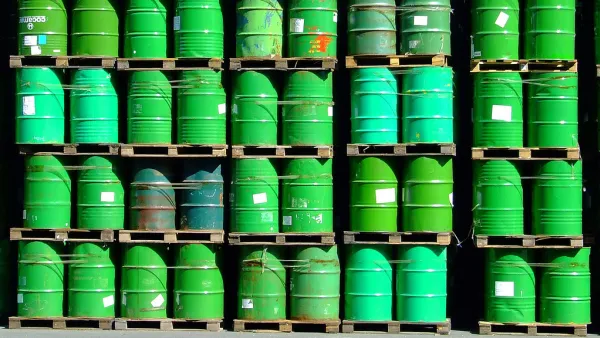
U.S. on Track to Record Oil Production This Year
The current U.S. record is 10 million barrels per day set in 1970. Last year averaged 9.2 million b/d. Experts believe that record will be reached this spring, if it hasn't already. Can Trump claim credit for the surging production?
Do Driverless Car Safety Features Merit Fuel Efficiency Credit?
Manufacturers say yes, arguing that the reduction in vehicle crashes decreases traffic congestion. Other features improve traffic flow. But these are safety technologies, not emission-reducing measures, that critics worry will water-down CAFE.
As Gas Prices Drop, VMT Rises
Sightline's Clark Williams-Derry looks at low gas prices, a down economy, and vehicle-miles-traveled, noting that the precipitous declines in VMT have halted, and suspects it may plateau.

Planetizen Federal Action Tracker
A weekly monitor of how Trump’s orders and actions are impacting planners and planning in America.

Eastern Nebraska is running out of electricity
Data centers and electrification are straining eastern Nebraska’s grid, throttling economic development.

Washington state to charge fee to drivers with fuel-efficient cars
Revenue from the fee will go towards supporting the state’s highways.

Instead of building new housing, LA developers are turning mansions into mega-mansions
In the richest areas, the number of houses valued at $30 million with demolition permits has skyrocketed since 2018.

Illinois considers spending $1 billion in taxpayer money on data center
A quantum computing campus and data center are currently under construction in Chicago.

As development costs rise, Boston moves to lessen affordable housing requirements
The Boston Zoning Commission and the City Council still need to approve Boston Mayor Michelle Wu’s proposed changes

FREE Course: Walkable City 1: Why Walkability?
After describing his path towards focusing on walkability as the essence of good planning, Jeff Speck marches through his five principal reasons for making more walkable places.
Reinventing Malls: Planning Alchemy—Turning Gray Fields Into Gold
The course focuses on the opportunities and imperatives that shape reinvention of mall sites.

City of Charlotte
City of Rosemead
Rutgers University, Edward J. Bloustein School of Planning and Public Policy
University of Michigan School for Environment and Sustainability (SEAS)
Hunter College, City University of New York (CUNY)
The Architects Foundation
University District Partnership
City of Cambridge
The Pocatello Development Authority