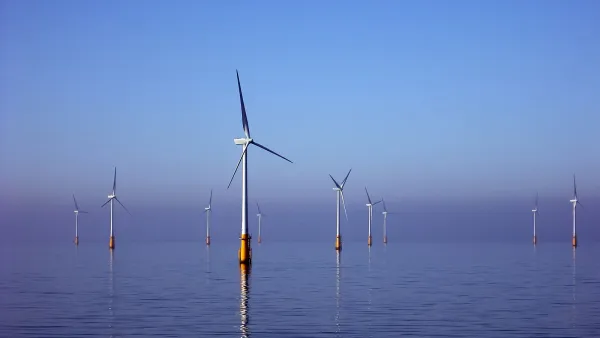
Building wind farms in the ocean is an ideal way to generate electricity, but it's not so easy to get that energy back to shore efficiently. This article looks as a transmission project that could address that issue.


"The Maryland-based transmission-line company Trans-Elect proposes to do just that with a $5-billion undersea power grid that would stretch some 350 miles from northern New Jersey to southern Virginia. The Atlantic Wind Connection (AWC) would provide multiple transmission hubs for future wind farms, making the waters off the mid-Atlantic coast an attractive and economical place for developers to set up turbines. The AWC's lines could transmit as much as six gigawatts of low-carbon power from turbines back to the coast-the equivalent capacity of 10 average coal-fired power plants.
So far, the project has attracted backing from Google, the clean-energy investment firm Good Energies, and the Japanese trading company Marubeni. Trans-Elect says it plans to begin construction on phase I-a $1.8 billion, 150-mile span from Delaware Bay to Atlantic City-in 2013, and that section could be operational by 2016."
Officials are hoping this infrastructure would enable and encourage more wind farm operators to consider a spot in the ocean.
Read the full story: Hundreds of Miles of Wind Farms, Networked Under the Sea
Wind Power at Sea
The competition is fierce and blustery in the business of off-shore wind energy generation, as companies vie to launch bigger and better wind turbines off the coast of the United Kingdom.
Harvesting the Wind on the Open Ocean
Offshore drilling company StatoilHydro is finding a new way to get energy at sea- with large-scale wind turbines.
Northern California Port Seeks Offshore Wind Lease
The Port of Humboldt has proposed a plan to modernize its facilities to accommodate offshore wind energy production, hoping to stimulate the local economy and create sustainable jobs.

Desperate measures: Advocates weigh draining Lake Powell to fill Colorado River
Draining the reservoir could reduce evaporation losses by a couple hundred thousand acre-feet.

Eastern Nebraska is running out of electricity
Data centers and electrification are straining eastern Nebraska’s grid, throttling economic development.

Malls are becoming the midtowns of the future
Mall and office park redevelopments are a generational opportunity to create new nodes of urbanity.

NYC breaks ground on anti-flooding infrastructure project
New York City's new system will reduce stormwater flows to local sewers by 90%.

One Kentucky town’s secret to affordable housing
The Smoketown Community Land Trust has already built seven affordable homes for community members.

Houston gains petal-shaped cooling infrastructure to make streets more ‘delightful’
The city has installed the pavilions along 15 blocks in Houston.

FREE Course: Walkable City 1: Why Walkability?
After describing his path towards focusing on walkability as the essence of good planning, Jeff Speck marches through his five principal reasons for making more walkable places.
Reinventing Malls: Planning Alchemy—Turning Gray Fields Into Gold
The course focuses on the opportunities and imperatives that shape reinvention of mall sites.

City of Rosemead
Rutgers University, Edward J. Bloustein School of Planning and Public Policy
One Hundred Miles
University of Michigan School for Environment and Sustainability (SEAS)
Hunter College, City University of New York (CUNY)
The Architects Foundation
City of Cambridge
Montrose County
The Pocatello Development Authority