The U.S. often gets a bad rap for its sprawling suburbs and unplanned development, but Robert Kwolek notes that many European cities and other parts of the world aren't far behind.


Europe is known for its quaint, compact villages and old city centers. But take a close look at its land use patterns, and you'll see that many European cities like Zug, Switzerland and Canary Wharf in London are experiencing the same kind of sprawl that's common in the U.S. In the post-war years, apartment complexes and industrial parks also spread out from the center of old European cities: cheap buildings built on cheap land with little thought to architecture and planning.
Robert Kwolek notes that this has some different (though still destructive) consequences in Europe, where most workers still live in city centers. Workers disperse from the cities during the day, cars are on the rise, and historic cities become nothing more than tourist attractions.
Read the full story: Disjointed Development Patterns

Myth and Reality About European Sprawl
Some commentators argue that sprawl is an inevitable result of affluence, based on European development patterns. These pundits tell a simple story: European urban cores are losing population and becoming more automobile-dependent - just like American cities. So if Europe can’t beat sprawl, neither can America.

European Cities Act on Density
The sprawling mass of suburbia has been a disaster for the environment. But now smaller, denser cities herald a renaissance in city living.
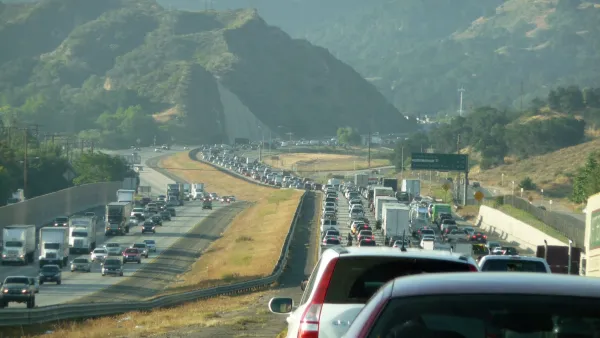
Cities and Automobile Dependence: What Have We Learned?
Thirty years ago Peter Newman and Jeff Kenworthy introduced the concept of automobile dependency. In this article they reexamine the evidence, consider criticisms, and discuss how their insights changed—sometimes painfully—planning practices.

Planetizen Federal Action Tracker
A weekly monitor of how Trump’s orders and actions are impacting planners and planning in America.

California plans to bury El Niño’s downpour
If the state plays its cards right, it may be able to store a billion acre-feet of El Niño’s water in aquifers.

Desperate measures: Advocates weigh draining Lake Powell to fill Colorado River
Draining the reservoir could reduce evaporation losses by a couple hundred thousand acre-feet.

California city breaks ground on transit connector
The project includes three mobility hubs and a pedestrian bridge.

After public outcry, Massachusetts city releases housing development tracker
Cambridge’s tracker currently shows 250 housing projects in various stages of development.

40 years after approval, Chicago breaks ground on new park
The park honors Jean Baptiste Point du Sable, the city’s first permanent non-native settler.

FREE Course: Walkable City 1: Why Walkability?
After describing his path towards focusing on walkability as the essence of good planning, Jeff Speck marches through his five principal reasons for making more walkable places.
Reinventing Malls: Planning Alchemy—Turning Gray Fields Into Gold
The course focuses on the opportunities and imperatives that shape reinvention of mall sites.

City of Rosemead
Rutgers University, Edward J. Bloustein School of Planning and Public Policy
One Hundred Miles
Hunter College, City University of New York (CUNY)
The Architects Foundation
University of Cincinnati Online
City of Cambridge
Montrose County
The Pocatello Development Authority