A number of large skyscrapers in London, approved and financed before the recession, are being completed. But with no new ones planned, these skyscrapers are looked at as the end of an age of large-scale building.


"While skyscrapers with nicknames such as the Shard, the Cheesegrater and the Walkie Talkie are joining the 40-story Gherkin as part of the British capital's skyline, those buildings reflect past rather than present considerations. All of the office towers that are due to open in London by 2014 were conceived before the financial crisis and developers are increasingly adopting cheaper, less ambitious plans.
Commercial Estates Group Ltd., a privately held developer, last month said it will review a plan to build a 63-story property adjacent to Canary Wharf. Hammerson Plc (HMSO), a real estate investment trust that owns seven London office buildings, in January abandoned its design for a 32-story tower and block in the City in favor of a 15-floor office complex."
Real estate watchers in London are predicting a much smaller and more reserved era of building in the coming years.
Read the full story: Skyscraper Boom Reaches End as City of London Goes 'From Vanity to Sanity'

New Skyscraper Blooming on London's Skyline
A new tulip-shaped tower designed by Foster + Partners is planned for London. Approval is still pending.
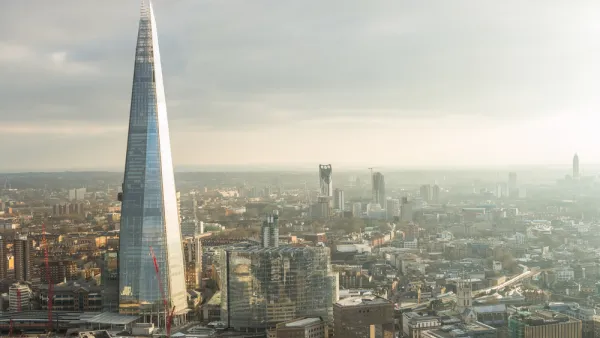
London's Skyline Getting a Tall Makeover
The Diamond will be the third tallest building in London when it's complete. The two taller buildings aren't built yet either.

London's Tallest Buildings Currently Under Construction
In a growing London, skyscrapers seem to be popping up everywhere, We Plan London catalogs the ten tallest.

Planetizen Federal Action Tracker
A weekly monitor of how Trump’s orders and actions are impacting planners and planning in America.

Washington state to charge fee to drivers with fuel-efficient cars
Revenue from the fee will go towards supporting the state’s highways.

Trump to blast ‘hydrocarbon highway’ through ‘world’s longest art gallery’
Environmental and historic preservation groups are suing to stop the project.

Minnesota Gold Line extension now has launch date
Plans to extend the Gold Line have existed since 2025.

Data centers need power – lower income, rural residents pay the price
In 2025, data centers paid only 38% of the energy infrastructure costs linked to their growth, with households, especially rural and low-income residents, bearing the remaining burden.

MBTA Green Line project moved to next phrase of CIG program
The modernization effort will cost $4.08 billion.

FREE Course: Walkable City 1: Why Walkability?
After describing his path towards focusing on walkability as the essence of good planning, Jeff Speck marches through his five principal reasons for making more walkable places.
Reinventing Malls: Planning Alchemy—Turning Gray Fields Into Gold
The course focuses on the opportunities and imperatives that shape reinvention of mall sites.

City of Charlotte
City of Rosemead
Rutgers University, Edward J. Bloustein School of Planning and Public Policy
University of Michigan School for Environment and Sustainability (SEAS)
Hunter College, City University of New York (CUNY)
The Architects Foundation
University District Partnership