This episode of 99% Invisible explores public spaces and their role in political change, and how over hundreds of years, riots have defined New York's Tompkins Square Park -- despite efforts to design unrest out.


In a recent article for Urban Omnibus, Vishaan Chakrabarti, Professor at the Graduate School for Architecture, Planning and Preservation at Columbia University, writes about the role of public places in political change. 99% Invisible looks at that thesis through the lens of New York's Tompkins Square Park.
"Host of WFMU's Too Much Information, Benjamen Walker, took a walk with Chakrabarti down to Tompkins Square Park to talk about the past and present design of the space and how the layout has affected the public actions that have taken place there. Chakrabarti also relates this to the current protests in the Middle East. Twitter and Facebook may have had a significant role in organizing the protests, but if there is no place for everyone to gather, what possible change can result?"
Read the full story: Episode 19- Liberation Squares + NY Dick

The New Way to Play
New playground designs are shaking up public parks around the world. So long, slides, hello interpretive playscapes.
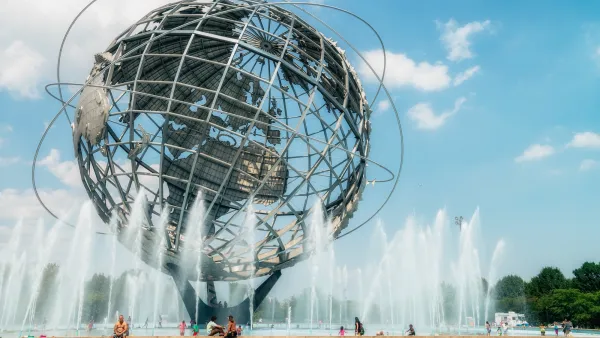
Historic Queens park is getting a $120M upgrade
The borough's largest park will undergo significant upgrades for accessibility, flood mitigation and historic preservation.
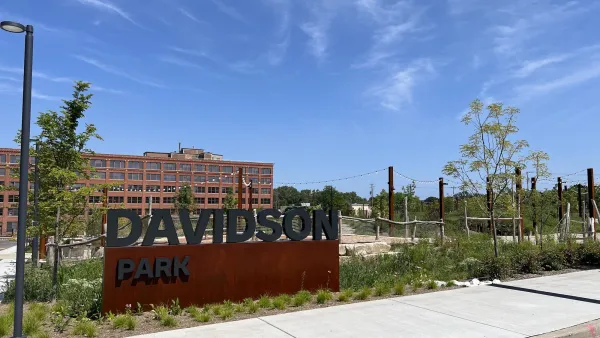
Harley-Davidson turned a Milwaukee parking lot into a green oasis
The park, adjacent to Harley-Davidson headquarters, doubles as stormwater retention infrastructure.

Planetizen Federal Action Tracker
A weekly monitor of how Trump’s orders and actions are impacting planners and planning in America.

California plans to bury El Niño’s downpour
If the state plays its cards right, it may be able to store a billion acre-feet of El Niño’s water in aquifers.

Chicago breaks ground on $3 billion megadevelopment
The new neighborhood, titled Foundry Park, will one day host 3,700 residences.

California High-Speed Rail Authority CEO resigns after $600,000 scandal
Under Ian Choudri, the authority used taxpayer dollars to fund first class flights and trips to nightclubs.

Want to study the Missouri River? Soon, you may need unanimous approval from 10 states
Legislation would require 10 governors’ permission to study or build projects moving water outside the basin.

Desperate measures: Advocates weigh draining Lake Powell to fill Colorado River
Draining the reservoir could reduce evaporation losses by a couple hundred thousand acre-feet.

FREE Course: Walkable City 1: Why Walkability?
After describing his path towards focusing on walkability as the essence of good planning, Jeff Speck marches through his five principal reasons for making more walkable places.
Reinventing Malls: Planning Alchemy—Turning Gray Fields Into Gold
The course focuses on the opportunities and imperatives that shape reinvention of mall sites.

City of Rosemead
Rutgers University, Edward J. Bloustein School of Planning and Public Policy
One Hundred Miles
Hunter College, City University of New York (CUNY)
The Architects Foundation
University of Cincinnati Online
City of Cambridge
Montrose County
The Pocatello Development Authority