Rep. Ann Marie Buerkle and Rep. Tom Reed of New York are leading an effort to stop New York from receiving any federal funding for high-speed rail projects.


Buerkle and Reed wrote a letter to Secretary Ray LaHood saying that "Constructing a high speed rail line across Western and Upstate New York is not practical."
The two Representatives specifically challenge the effectiveness of the plan to run high-speed rail on the same tracks as freight in the state. However, when it comes to building a new, true high-speed rail track, Buerkle and Reed say "our tax dollars would be better spent elsewhere."
LaHood and the DOT are considering awarding much of the $2.4 billion recently rejected by Florida to New York, as U.S. Senator Kirsten Gillibrand supports.
For continuing high-speed rail coverage, visit The Railist, a Planetizen news site.
Read the full story: Buerkle and Reed voice opposition against high speed rail funds
When Regressive is Progressive
With the two Democrat candidates debating who is the real progressive, it would be interesting to see how they would respond, if asked, about President Obama's proposed $10-per-barrel fee to fund a 21st Century Clean Transportation System.
Did Republicans Orchestrate a National High-Speed Derailment?
Was the demise of plans for high-speed rail in several states run by Republican governors the result of fiscal prudence or a case of political collusion? A new report in the Tampa Tribune suggests the latter.
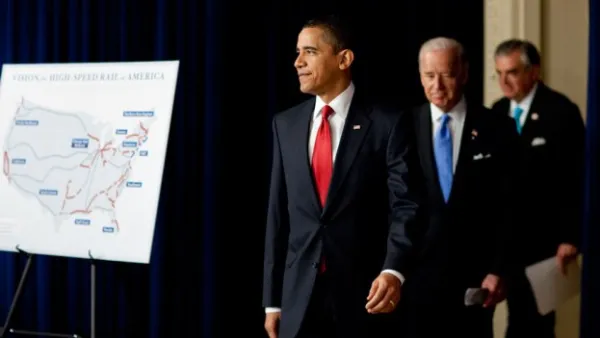
Obama's Grand Rail Plans: What Went Wrong?
Four years after a historic down payment was made on Pres. Obama's plan to connect 80 percent of Americans to fast trains, "the prospects for a national high-speed rail system seem bleak." Politics and funding challenges have derailed the plan.

Planetizen Federal Action Tracker
A weekly monitor of how Trump’s orders and actions are impacting planners and planning in America.

California plans to bury El Niño’s downpour
If the state plays its cards right, it may be able to store a billion acre-feet of El Niño’s water in aquifers.

Desperate measures: Advocates weigh draining Lake Powell to fill Colorado River
Draining the reservoir could reduce evaporation losses by a couple hundred thousand acre-feet.

Los Angeles just elected an urban planner as its mayor
Transportation analysts are optimistic that Raman will be more aggressive in addressing transit issues than Bass.

Mamdani’s pied-à-terre tax survives legal challenge
A panel of judges found that the plaintiffs failed to demonstrate injury as a result of New York City's implementation of the tax.

Eastern Nebraska is running out of electricity
Data centers and electrification are straining eastern Nebraska’s grid, throttling economic development.

FREE Course: Walkable City 1: Why Walkability?
After describing his path towards focusing on walkability as the essence of good planning, Jeff Speck marches through his five principal reasons for making more walkable places.
Reinventing Malls: Planning Alchemy—Turning Gray Fields Into Gold
The course focuses on the opportunities and imperatives that shape reinvention of mall sites.

City of Rosemead
Rutgers University, Edward J. Bloustein School of Planning and Public Policy
One Hundred Miles
University of Michigan School for Environment and Sustainability (SEAS)
Hunter College, City University of New York (CUNY)
The Architects Foundation
City of Cambridge
Montrose County
The Pocatello Development Authority