Service will be cut 44%, half the stations to close, elimination of mid-day and weekend service - that is the scenario laid for Caltrain, the West's oldest commuter rail, unless $30 million can be found - unlikely.


"Caltrain leaders said the station closures and service cuts will be necessary starting July 2 to survive a record $30.3 million deficit -- about one-third of Caltrain's operating budget -- unless they receive an influx of last-minute funding from outside sources, which they say is increasingly unlikely. The board does not expect to make a decision on the cuts until April."
The free-fall was triggered when one of the three member agencies, Samtrans, indicated it was financially unable to meet its 'member contribution', which in turn spiraled, per the joint operating agreement of the 3-county authority, to Santa Clara Valley Transportation Authority and San Francisco Municipal Transportation Authority to reduce their contributions by the same 67%.
From Palo Alto Online: Caltrain board: 'The crisis is at hand: "(Executive Director Mike) Scanlon blamed SamTrans, which has announced it must reduce its share of subsidies to Caltrain by $10 million, for causing much of Caltrain's current problem. SamTrans is facing a crisis of its own and could halve its service in three years, he said.
More than half of SamTrans' long-term debt is for the BART extension into San Mateo County (to connect with San Francisco International Airport), he said. The agency is trying to amortize the $13 million over 25-30 years, he said."
Read the full story: Caltrain proposes shuttering half its station
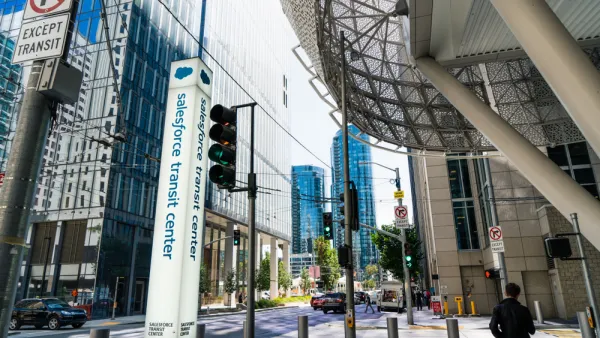
San Francisco Tunnel Project Balloons in Cost
The plan to extend a Caltrain line to the Salesforce Transit Center is now expected to cost $6.7 billion as the agency faces a budget shortfall for its electrification project.
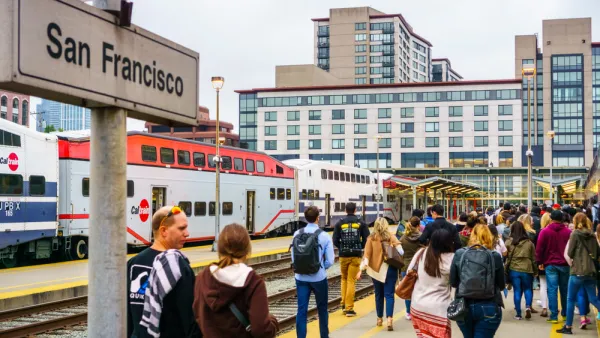
Compromise Reached to Save Caltrain
The saga of the three-county sales tax upon which the future of Caltrain depends is now in the hands of voters.
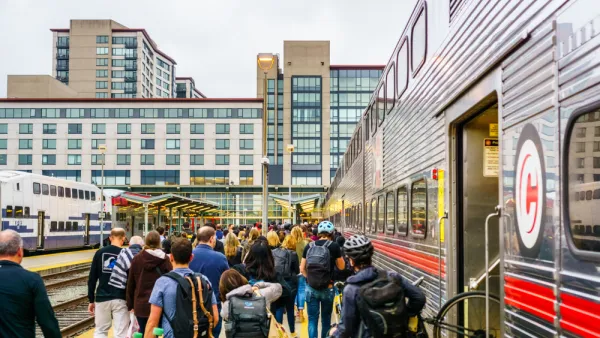
Plan to Save Caltrain Emerges
Elected officials in San Francisco and Santa Clara counties have produced a counter proposal after killing a proposed sales tax last week.

Planetizen Federal Action Tracker
A weekly monitor of how Trump’s orders and actions are impacting planners and planning in America.

Eastern Nebraska is running out of electricity
Data centers and electrification are straining eastern Nebraska’s grid, throttling economic development.

Study reveals best places in the U.S. for cycling, walking
New research from Streetlight Data examines bicycle and pedestrian miles per capita in the 100 largest U.S. cities by population.

DSA members accuse Mamdani of 'abandoning values' over housing redevelopment
New York City's mayor plans to replace about 2,000 units of public housing with private, mixed-income housing.

All sides of BRT debate unhappy with CDOT’s most recent move
The Colorado Department of Transportation is no longer considering center-running bus lanes for Colorado Boulevard.

Massachusetts bogs generate both power, and cranberries
Putting solar panels above farmland is one way Massachusetts is advancing toward its goal of net-zero carbon emissions by 2050.

FREE Course: Walkable City 1: Why Walkability?
After describing his path towards focusing on walkability as the essence of good planning, Jeff Speck marches through his five principal reasons for making more walkable places.
Reinventing Malls: Planning Alchemy—Turning Gray Fields Into Gold
The course focuses on the opportunities and imperatives that shape reinvention of mall sites.

City of Rosemead
Rutgers University, Edward J. Bloustein School of Planning and Public Policy
One Hundred Miles
University of Michigan School for Environment and Sustainability (SEAS)
Hunter College, City University of New York (CUNY)
The Architects Foundation
City of Cambridge
The Pocatello Development Authority
The Urban Renewal Agency of the City of Pocatello