James Griffioen debunks the myth that his hometown is in want of grocery stores.


Griffioen says he is accustomed to journalists making "sensational claims" and spreading "damaging falsehoods" about Detroit, but he is particularly perturbed by the notion that Detroiters can't find fresh produce without driving to the suburbs. He goes on to catalog the numerous local chains, independent stores, urban agriculture operations and large-scale farmer's market that serve the city's residents.
While many of Detroit's neighborhoods are indeed impoverished, says Griffioen, perpetuating the myth that the city is a "food desert" does nothing to solve the problem.
He writes:
"Sticking a pristine Whole Foods or even a Super Wal-Mart in these neighborhoods is not going to somehow solve the dietary issues poverty has created among their residents or provide jobs without displacing others. Those are incredibly complex problems and simply spreading hyperbole about a uniform lack of shopping options across a 138-square-mile city does nothing to solve it. Detroit does have individuals and organizations working hard to solve the problem of access to produce where it exists, and their efforts are often ignored by a media obsessed with the myth that Detroit has no grocery stores."
FULL STORY: Yes There Are Grocery Stores in Detroit

Food Deserts Exaggerated
The "food deserts" problem is receiving heightened attention following the release of the USDA's locator map. But this analysis relies on the suspect premise that suburban supermarkets are superior to small, walkable urban foodsellers.
Combatting the Food Desert of Detroit
Grist's food editor visits Detroit, where the lack of grocery stores has inspired a number of innovative, locally-grown food projects.
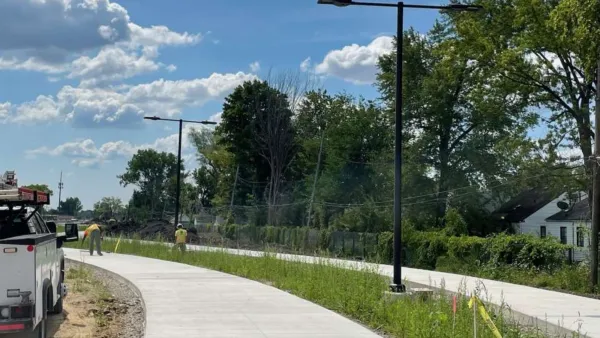
Detroit greenway brings revival — and fears of displacement
The planned Joe Louis Greenway is already bringing change to the neighborhoods near it.

Planetizen Federal Action Tracker
A weekly monitor of how Trump’s orders and actions are impacting planners and planning in America.

The state-sanctioned urbicide of Austin
People don’t kill cities. Freeways do.

US to reduce Colorado River water deliveries to Mexico
A new Colorado Treaty amendment reduces Mexico’s Colorado River water allocation by 250,000 acre feet.

5 New England states march closer to 800 megawatt wind energy project
Securing federal approval for the project may be complicated under the Trump administration, which has historically been hostile towards domestic wind power.

Baltimore to break ground on $50 million Transit Priority Project
The project will bring faster bus trips, safer streets and better bike connections to Baltimore.

Airbnb launches $250 million 'last-dollar financing' housing accelerator, makes first investment in Austin
The company will put $6.4 million towards affordable housing development in Texas’ capital.

FREE Course: Walkable City 1: Why Walkability?
After describing his path towards focusing on walkability as the essence of good planning, Jeff Speck marches through his five principal reasons for making more walkable places.
Reinventing Malls: Planning Alchemy—Turning Gray Fields Into Gold
The course focuses on the opportunities and imperatives that shape reinvention of mall sites.

Eagle County Government
Harvard University Graduate School of Design
Nashville Planning Department
The Architects Foundation
University of Cincinnati Online
The Pocatello Development Authority
The Urban Renewal Agency of the City of Pocatello
Journal of the American Planning Association