There are 12 community benefit districts in San Francisco, which raise their own taxes to create funds for various local projects. But some argue they favor big businesses.


"[S]ince the first district was approved for Union Square in 1999, there have been concerns that those community efforts benefit the business community and not the city as a whole.
While businesses typically try to block attempts by the city to boost taxes or fees that will aid the entire community, they're willing to pay when they get to decide where the money will go, said Jennifer Friedenbach, executive director of the city's Coalition on Homelessness.
'The choices they make are always in the interest of big business,' she added. 'It's very anti-democratic.'"
Some argue that weighted voting based on the size of businesses allows major business owners to steamroll smaller businesses to create the districts.
Read the full story: SF community benefit districts praised, criticized
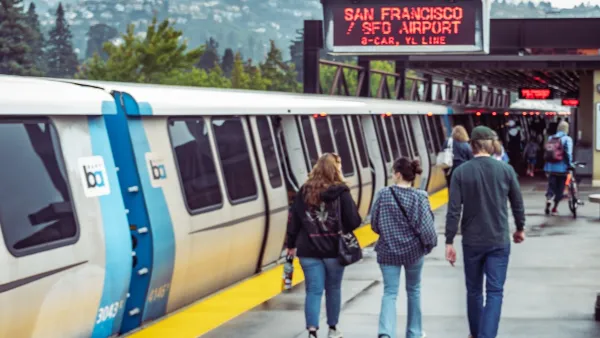
Bay area voters pass ‘crucial lifeline’ for transit
Proposition RTM, which will fund Bay Area transit, has approval from 61% of voters as of 9:45 p.m. on Nov. 3.

California High-Speed Rail Authority picks trainset manufacturer
The California High-Speed Rail Authority aims to start servicing passengers by 2033.
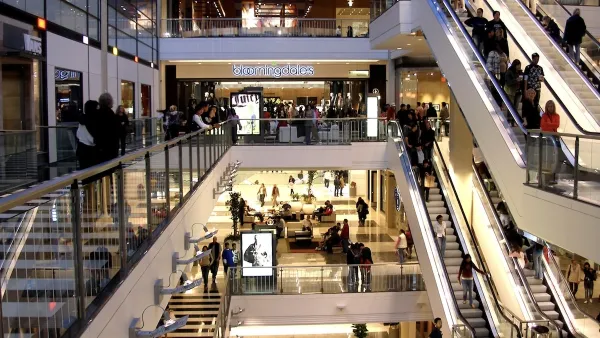
SF weighs putting data center inside abandoned mall
An unnamed technology company may buy the entire building, and convert one-third of it into what development consultants are calling a “regenerative urban energy center.”

Planetizen Federal Action Tracker
A weekly monitor of how Trump’s orders and actions are impacting planners and planning in America.

California plans to bury El Niño’s downpour
If the state plays its cards right, it may be able to store a billion acre-feet of El Niño’s water in aquifers.

Desperate measures: Advocates weigh draining Lake Powell to fill Colorado River
Draining the reservoir could reduce evaporation losses by a couple hundred thousand acre-feet.

Los Angeles just elected an urban planner as its mayor
Transportation analysts are optimistic that Raman will be more aggressive in addressing transit issues than Bass.

Mamdani’s pied-à-terre tax survives legal challenge
A panel of judges found that the plaintiffs failed to demonstrate injury as a result of New York City's implementation of the tax.

Eastern Nebraska is running out of electricity
Data centers and electrification are straining eastern Nebraska’s grid, throttling economic development.

FREE Course: Walkable City 1: Why Walkability?
After describing his path towards focusing on walkability as the essence of good planning, Jeff Speck marches through his five principal reasons for making more walkable places.
Reinventing Malls: Planning Alchemy—Turning Gray Fields Into Gold
The course focuses on the opportunities and imperatives that shape reinvention of mall sites.

City of Rosemead
Rutgers University, Edward J. Bloustein School of Planning and Public Policy
One Hundred Miles
University of Michigan School for Environment and Sustainability (SEAS)
Hunter College, City University of New York (CUNY)
The Architects Foundation
City of Cambridge
Montrose County
The Pocatello Development Authority