Sam Staley says that new Republican appointees to the U.S. House Committee on Transportation and Infrastructure are primarily from rural districts, which doesn't bode well for urban transit funding.


Staley, a frequent Planetizen contributor, writes:
"Under the leadership of former Congressman Jim Oberstar, transit programs and pro-transit policy were on center stage. By their nature, these policies tended to be city-specific and urban centric. Thus, federal spending priorities shifted toward explicit support for urban areas through subsidies for their transit programs and promoting initiatives such as "livability."
In contrast, the Republican controlled committee will likely shift discussions to transportation policy objectives that are more national in scope and impact."
Read the full story: Transit Faces Tough Road Ahead in U.S. Congress

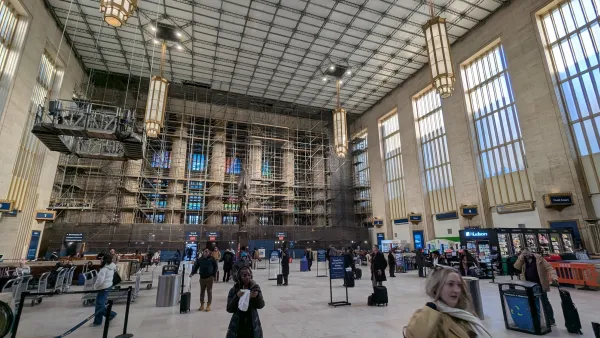
Pennsylvania 12-year transportation plan commits $13B for transit
The state's new mid-range transportation strategy includes nearly $17 billion for roads and bridges and $367 million for multimodal projects.

Congress Introduces Bill to Block Hedge Funds from Buying Single-Family Homes
The proposed legislation aims to help U.S. home buyers who can’t afford to outbid deep-pocketed institutional investors.

Five-Year Transportation Bill Has a Ways to Go
House and Senate versions of the five-year surface transportation reauthorization bill are on different tracks, headed in different directions.

Planetizen Federal Action Tracker
A weekly monitor of how Trump’s orders and actions are impacting planners and planning in America.

Amtrak, CN end decades-long dispute with eight-year agreement
The new operating agreement establishes an updated framework for the companies to work together, including processes to resolve disputes.

Judges permit Denver to divert 77,000 acre feet from the Colorado River for reservoir expansion
Overuse and climate change have caused the Colorado River’s water levels to plummet.

Boston has spent millions making the Green Line more accessible — and there’s no end in sight
While the city has invested millions into expanding and adding platforms to the Green Line to make it more accessible, new train cars set to arrive next year will be too tall for disabled passengers to board without raising the current platforms.

Idaho may see an 18% drop in federal surface transit funding — the largest estimated cut in the US
Transit systems in rural communities are much more reliant on federal funding to provide their services.

How ‘post-disaster gentrification’ alters neighborhoods after natural calamities
After hurricanes, fires or other calamities, the original residents of a community are often replaced by younger, wealthier residents.

FREE Course: Walkable City 1: Why Walkability?
After describing his path towards focusing on walkability as the essence of good planning, Jeff Speck marches through his five principal reasons for making more walkable places.
Reinventing Malls: Planning Alchemy—Turning Gray Fields Into Gold
The course focuses on the opportunities and imperatives that shape reinvention of mall sites.

Harvard University Graduate School of Design
KFH Group Inc.
Greater Baltimore Committee
The Architects Foundation
University of Cincinnati Online
The Pocatello Development Authority
The Urban Renewal Agency of the City of Pocatello