House and Senate versions of the five-year surface transportation reauthorization bill are on different tracks, headed in different directions.



"Funding for public transportation is one of the sticking points as Congress considers reauthorizing the nation's surface transportation legislation," writes Chris Teale.
And there's clearly some middle ground yet to be found between House and Senate versions of the bill.
House Democrats recently "introduced the Investing in a New Vision for the Environment and Surface Transportation in America (INVEST in America) Act, a $547 billion, five-year reauthorization bill."
The Senate Environment and Public Works Committee voted in May to advance the Surface Transportation Reauthorization Act of 2021. While the Senate's version of the bill attracted criticism from transit advocates, the House Democrats' version of the bill is proving much more popular.
"There’s a lot of great, some good, a few things that could use further refinement, and a couple of missed opportunities; but nothing that falls into the category of 'bad,' much less 'ugly,'" according to a post by Stephen Lee Davis for Transportation for America.
As for the details, Teale provides the following: "Included in the bill, which Democrats first introduced last year, is $109 billion for transit, which committee leaders called 'record investments.' The purpose of the money is to increase routes and reduce public transportation’s maintenance backlog, which previous estimates have indicated will cost around $90 billion."
FULL STORY: Transit funding a flashpoint in surface transportation debate

Restoring Solvency to the Highway Trust Fund
The Highway Trust Fund, the nation's source of road and bridge funding, went bankrupt in 2008 and has since relied on transfers from the General Fund to supplement fuel taxes. Republican Senators have proposed a new funding source: an EV fee.
Historic 'Infrastructure Investment and Jobs Act' Passes Final Hurdle in Congress, Heads to Biden for Signature
Months after the Senate voted to approve the Infrastructure Investment and Jobs Act in a historic moment of bipartisan legislation, the House of Representatives put the finishing touches on a $1.2 trillion bill with $550 million in new spending.
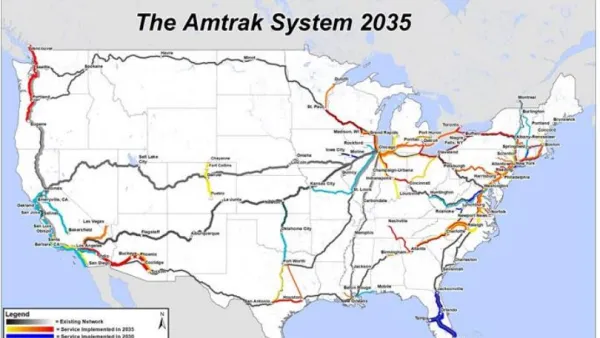
Amtrak Proposes Five New Routes in Ohio
The nation’s most populous state without an intercity passenger rail program could be the benefit of ambitions to expand the network of Amtrak service around the country.

The state-sanctioned urbicide of Austin
People don’t kill cities. Freeways do.

US to reduce Colorado River water deliveries to Mexico
A new Colorado Treaty amendment reduces Mexico’s Colorado River water allocation by 250,000 acre feet.

New Jersey’s second-largest city bans standalone data centers
Jersey City will continue to allow co-location facilities, such as those meant for research institutions that store their own data.

Amtrak not solely to blame for New Jersey commuter rail's unreliability, report finds
A new study from the Garden State Initiative found that NJ Transit’s budget grew 20% across a 4 year period, but reliability declined significantly over the same period.

EPA erases limits on planet-warming pollution from power plants
Under Monday’s plan, power plants would still have some limits on how much mercury, arsenic and other contaminants they can emit.

Phoenix announces new on-demand transit service, more frequent RAPID buses
Both new services will launch in October, and are part of Phoenix's Project Effective Access Solutions for Easing Congestion.

FREE Course: Walkable City 1: Why Walkability?
After describing his path towards focusing on walkability as the essence of good planning, Jeff Speck marches through his five principal reasons for making more walkable places.
Reinventing Malls: Planning Alchemy—Turning Gray Fields Into Gold
The course focuses on the opportunities and imperatives that shape reinvention of mall sites.

Eagle County Government
Harvard University Graduate School of Design
Nashville Planning Department
The Architects Foundation
University of Cincinnati Online
The Pocatello Development Authority
The Urban Renewal Agency of the City of Pocatello
Journal of the American Planning Association