Thousands of Louisiana residents are being forced to retreat from their rapidly disappearing coastal communities.


This article from On Earth magazine visits the coast to find communities and their histories being deserted.
"Louisiana's bottom-most ribbon is literally sinking, and taking communities with it. According to David Burley, an assistant professor of sociology at Southeastern Louisiana University, the Pointe-au-Chien tribe's experience is being replicated throughout the region. "Tropical storms batter these places like they didn't do 20 years ago because of the land loss," says Burley, whose 2010 book Losing Ground documents the phenomenon. "Damage accumulates, accumulates, accumulates, and then you have the oil spill and the continuing decline of fishing." In 2007, the Christian Science Monitor reported that 10,000 Louisianans have migrated northward as coastal lands have disappeared. Two experts I checked with -- Burley and Kristina Peterson, a senior researcher at the University of New Orleans' Center for Hazards Assessment, Response, and Technology -- believe this represents a vast undercount."
Read the full story: 'The Land is Washing Back to the Sea'
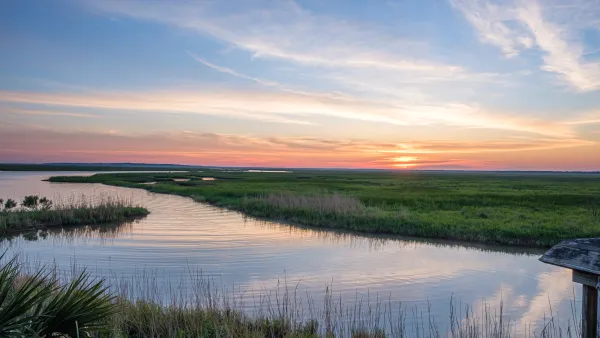
Louisiana Approves Coastal Restoration Master Plan
The latest update to a state-mandated coastal protection and restoration plan calls for wetlands restoration and new levees to protect communities from flooding.
As El Niño approaches, Newsom vetos bill aimed at protecting California levees from flooding
Gov. Gavin Newsom said the state’s allocated $170 million was enough funding; State experts estimate it will cost $3.3 billion to repair the California Delta's levees.

94% of wetlands could lose federal protections under proposed EPA rule
The ruling would only allot federal protections to waterways that flow nearly everyday, which few wetlands do.

Planetizen Federal Action Tracker
A weekly monitor of how Trump’s orders and actions are impacting planners and planning in America.

Eastern Nebraska is running out of electricity
Data centers and electrification are straining eastern Nebraska’s grid, throttling economic development.

Study reveals best places in the U.S. for cycling, walking
New research from Streetlight Data examines bicycle and pedestrian miles per capita in the 100 largest U.S. cities by population.

DSA members accuse Mamdani of 'abandoning values' over housing redevelopment
New York City's mayor plans to replace about 2,000 units of public housing with private, mixed-income housing.

All sides of BRT debate unhappy with CDOT’s most recent move
The Colorado Department of Transportation is no longer considering center-running bus lanes for Colorado Boulevard.

Massachusetts bogs generate both power, and cranberries
Putting solar panels above farmland is one way Massachusetts is advancing toward its goal of net-zero carbon emissions by 2050.

FREE Course: Walkable City 1: Why Walkability?
After describing his path towards focusing on walkability as the essence of good planning, Jeff Speck marches through his five principal reasons for making more walkable places.
Reinventing Malls: Planning Alchemy—Turning Gray Fields Into Gold
The course focuses on the opportunities and imperatives that shape reinvention of mall sites.

City of Rosemead
Rutgers University, Edward J. Bloustein School of Planning and Public Policy
One Hundred Miles
University of Michigan School for Environment and Sustainability (SEAS)
Hunter College, City University of New York (CUNY)
The Architects Foundation
City of Cambridge
The Pocatello Development Authority
The Urban Renewal Agency of the City of Pocatello