Architecture critic Sarah Williams Goldhagen says that streets can't create public interaction in the way that unstructured spaces like urban parks can.


Goldhagen argues that people won't interact unless they're given public spaces that are unstructured and non-goal-oriented enough to give our brains the space to focus on other people:
"Goldhagen argues that only in places that have been designed to foster these social interactions can people once again enjoy the company of strangers not interested in your specific "community of interest." The obvious physical space for the public realm then is public parks, in all their forms, but particularly, the 'great urban parks.'"
She says that the ideal urban park is "not be so large that inside it one loses a sense of the city."
Read the full story: Goldhagen: “Democracies Need Physical Spaces”

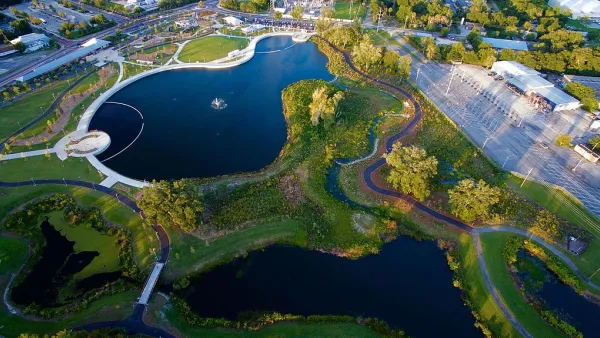
Gainesville Turns Abandoned Industrial Hub Into Innovative Park
Gainesville turns contaminated land into a contemporary public greenspace to serve as the city's “Central Park."
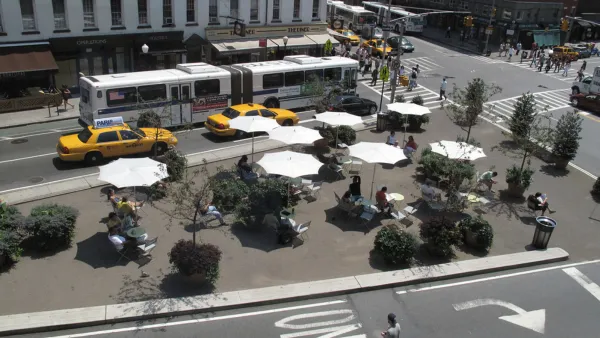
Pavement Parks: a Better Parklet Alternative
Too often, street-side parklets become little more than semi-private patios for the businesses that sponsor them. Pavement parks, replacing dangerous intersections, may be a more worthwhile option.
Rose Kennedy Greenway is a "Placeless Desert"
Boston's Rose Kennedy Greenway is an urban park built over the "Big Dig" highway tunnel, and as Robert Campbell of the Boston Globe puts it, "a design disaster."

Planetizen Federal Action Tracker
A weekly monitor of how Trump’s orders and actions are impacting planners and planning in America.

Amtrak, CN end decades-long dispute with eight-year agreement
The new operating agreement establishes an updated framework for the companies to work together, including processes to resolve disputes.

Judges permit Denver to divert 77,000 acre feet from the Colorado River for reservoir expansion
Overuse and climate change have caused the Colorado River’s water levels to plummet.

NYC DOT wants faster, more permanent street upgrades
The city is examining ways to build more concrete infrastructure without getting entangled in 'decades-long' projects.

'Something we’ve never seen before:' rising utility rates could strain city finances nationwide
Data centers, climate change and other factors have caused utility rates in the United States to increase by 38% since 2020.

Trump to overrule local leaders, lease millions of acres of America’s Pacific Island territories’ seafloors to mining companies
International law says that the Indigenous people of America’s territories have a right to prior and informed consent regarding projects that impact their countries.

FREE Course: Walkable City 1: Why Walkability?
After describing his path towards focusing on walkability as the essence of good planning, Jeff Speck marches through his five principal reasons for making more walkable places.
Reinventing Malls: Planning Alchemy—Turning Gray Fields Into Gold
The course focuses on the opportunities and imperatives that shape reinvention of mall sites.

Harvard University Graduate School of Design
KFH Group Inc.
Greater Baltimore Committee
The Architects Foundation
University of Cincinnati Online
The Pocatello Development Authority
The Urban Renewal Agency of the City of Pocatello