A bill working its way through congress seeks to institute more "livable communities" in America. But with few mandates, it's unclear what the bill would actually do.


"[I]t's no surprise that the bill reads like a New Urbanist tract. It states, for instance, "Demographers estimate that as much as 30 percent of current demand for housing is for housing in dense, walkable, mixed-use communities, and that less than 2 percent of new housing is in this category." It argues that less driving is "a necessary part of the energy independence and climate change strategies of the United States." The bill contains remarkably enlightened rhetoric, but it doesn't quite walk the walk. Like much of what comes out of the Obama administration, S.1619 is neither as far-reaching as its proponents would like nor as radical as its detractors claim."
The bill focuses on encouraging discussion and coordination between various arms of government and policymaking, as opposed to creating hard rules. But proponents say it's a good, though modest, first step.
Read the full story: All Carrot, No Stick
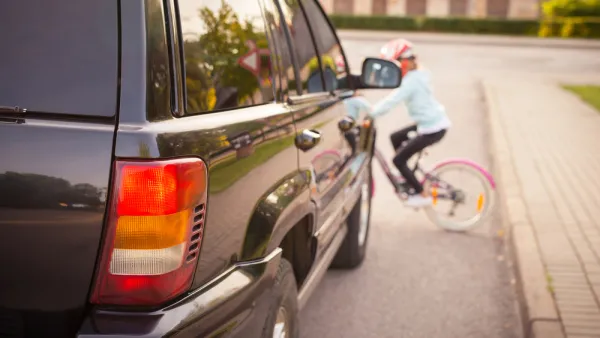
Congress Introduces Bill to Limit Size of SUVs and Trucks
Lawmakers want the federal government to set standards for vehicle height and visibility to combat the sharp rise in pedestrian deaths over the past decade.

Undoing Biden's EV Rule
The partisan divide over how government should reduce greenhouse gas emissions was on full display after the Biden administration finalized its emissions standards rule for light and medium duty vehicles on March 20.
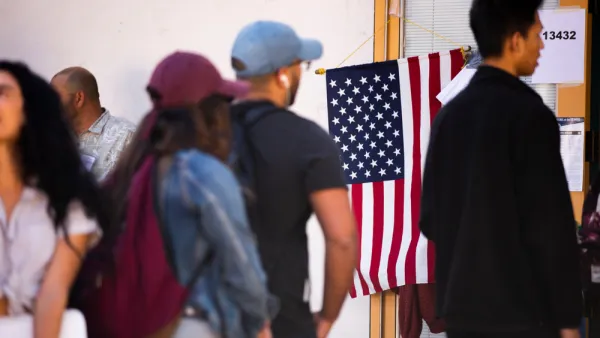
Brookings: A Demographic Post-Mortem of the Midterms
Young adults, according to a deep dive analysis by Brookings Metro demographer William Frey, were a key demographic group responsible for stopping the red wave that most polling predicted as the likely outcome of last month's midterm elections.

Planetizen Federal Action Tracker
A weekly monitor of how Trump’s orders and actions are impacting planners and planning in America.

California plans to bury El Niño’s downpour
If the state plays its cards right, it may be able to store a billion acre-feet of El Niño’s water in aquifers.

Desperate measures: Advocates weigh draining Lake Powell to fill Colorado River
Draining the reservoir could reduce evaporation losses by a couple hundred thousand acre-feet.

Mamdani’s pied-à-terre tax survives legal challenge
A panel of judges found that the plaintiffs failed to demonstrate injury as a result of New York City's implementation of the tax.

Eastern Nebraska is running out of electricity
Data centers and electrification are straining eastern Nebraska’s grid, throttling economic development.

Seattle passes record-breaking transit services expansion
Proposition 1 will double the city’s transit tax to add 95,000 more bus trips and preserve 180,000 bus trips annually.

FREE Course: Walkable City 1: Why Walkability?
After describing his path towards focusing on walkability as the essence of good planning, Jeff Speck marches through his five principal reasons for making more walkable places.
Reinventing Malls: Planning Alchemy—Turning Gray Fields Into Gold
The course focuses on the opportunities and imperatives that shape reinvention of mall sites.

City of Rosemead
Rutgers University, Edward J. Bloustein School of Planning and Public Policy
One Hundred Miles
Hunter College, City University of New York (CUNY)
The Architects Foundation
University of Cincinnati Online
City of Cambridge
Montrose County
The Pocatello Development Authority