The atmosphere has latent architectural possibilities, writes Javier Arbona in this intriguing essay on the potential of air and atmosphere in urban design and architecture.


Citing examples built and imagined of architectural roles for the atmosphere, this wide-ranging essay touches on topics from weaponized air to visualized pollens and pollutants to aerosolized pig brains that can impair human motor functions.
"[A] growing number of artists and architects are engaging air in new ways. They are exploring air as a design component, studying how airborne particles can be manipulated into various textures, surfaces and spaces. They are transforming the scales at which architects typically work. And they are bringing the multiple temporalities of air into play through designs that actually collect and archive air from different times. This work could bring about a new consciousness and perhaps an expanded understanding of the meaning of a public architecture - an effort to reclaim the air from those who've attempted to control it in irresponsible and dangerous ways."
Read the full story: Dangers in the Air: Aerosol Architecture and Invisible Landscapes

Finding New Uses for the 'Vine That Ate the South'
Visually striking and aggressively invasive, kudzu has been choking the Southeast for decades. Now, designers, chefs, and activists want to find ways to make it useful.
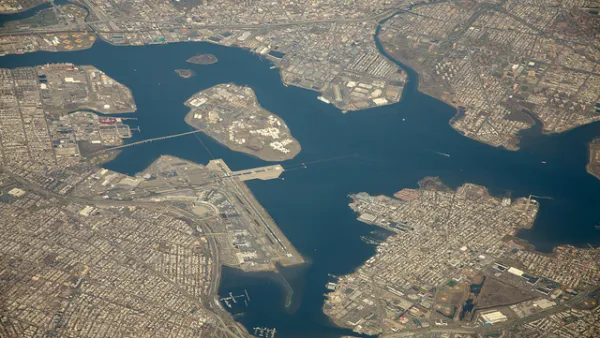
The Happy Jail
Where do the street trees come from, and where does the compost go? Rikers Island was New York City's growing outpost for years. But does “greening” the jail always improve things for prisoners?
Friday Eye Candy: How USGS Surveys Helped Build Pixar's New Dream World
Jody Avirgan shares insight into a new podcast with the creators of the new Pixar movie The Good Dinosaur, which reads like more of an advertisement for the U.S. Geological Survey (USGS).

Planetizen Federal Action Tracker
A weekly monitor of how Trump’s orders and actions are impacting planners and planning in America.

Eastern Nebraska is running out of electricity
Data centers and electrification are straining eastern Nebraska’s grid, throttling economic development.

Washington state to charge fee to drivers with fuel-efficient cars
Revenue from the fee will go towards supporting the state’s highways.

Instead of building new housing, LA developers are turning mansions into mega-mansions
In the richest areas, the number of houses valued at $30 million with demolition permits has skyrocketed since 2018.

Illinois considers spending $1 billion in taxpayer money on data center
A quantum computing campus and data center are currently under construction in Chicago.

As development costs rise, Boston moves to lessen affordable housing requirements
The Boston Zoning Commission and the City Council still need to approve Boston Mayor Michelle Wu’s proposed changes

FREE Course: Walkable City 1: Why Walkability?
After describing his path towards focusing on walkability as the essence of good planning, Jeff Speck marches through his five principal reasons for making more walkable places.
Reinventing Malls: Planning Alchemy—Turning Gray Fields Into Gold
The course focuses on the opportunities and imperatives that shape reinvention of mall sites.

City of Charlotte
City of Rosemead
Rutgers University, Edward J. Bloustein School of Planning and Public Policy
University of Michigan School for Environment and Sustainability (SEAS)
Hunter College, City University of New York (CUNY)
The Architects Foundation
University District Partnership
City of Cambridge
The Pocatello Development Authority