Arizona's long-standing open range laws allow cattle to roam freely, but the state is now reconsidering the laws as residents of the West's suburban subdivisions are growing more frustrated by encounters with roaming cattle.


Marc Lacey writes:
"Free-range cattle roam widely across the West, protected by centuries-old laws that give them the right of way while grazing and force landowners to fence them out. But as urban sprawl has extended into what used to be seemingly endless pasture land, cow-friendly open range laws are under fresh scrutiny, criticized as anachronistic throwbacks to the Wild West days before Interstate highways and tract homes."
Today, cattle are roaming through bedroom communities in freshly-sprouted suburbs, crashing through fences and into gardens, and have even caused deaths as people collide with them in cars.
But while landowners and suburban residents see the free-ranging cattle as a clear nuisance, the ranching community and industry officials feel that changing the law would be devastating to ranchers who are already struggling to get by.
Read the full story: Arizona Rethinking Open Range Laws
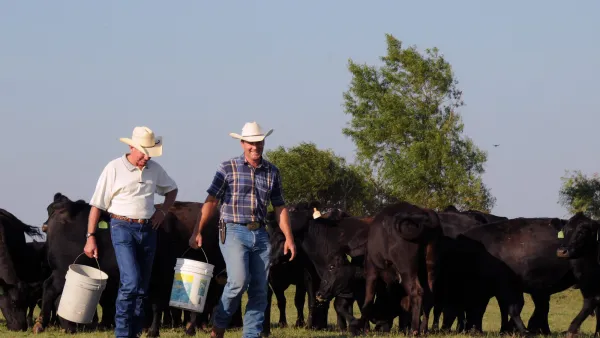
Film Highlights Conservationists' Diversity
This documentary complicates what can seem like a stark partisan divide on the environment, highlighting the many heartland residents who do conservation work.
Farming the Subdivision
Agricultural spaces are increasingly being included in housing developments.
Feds say Arizona, California and Nevada must cut Colorado River water use by 1.25 million acre-feet
The new plan does not apply mandatory cuts to any of the river’s upper basin states.

Planetizen Federal Action Tracker
A weekly monitor of how Trump’s orders and actions are impacting planners and planning in America.

Eastern Nebraska is running out of electricity
Data centers and electrification are straining eastern Nebraska’s grid, throttling economic development.

Study reveals best places in the U.S. for cycling, walking
New research from Streetlight Data examines bicycle and pedestrian miles per capita in the 100 largest U.S. cities by population.

DSA members accuse Mamdani of 'abandoning values' over housing redevelopment
New York City's mayor plans to replace about 2,000 units of public housing with private, mixed-income housing.

All sides of BRT debate unhappy with CDOT’s most recent move
The Colorado Department of Transportation is no longer considering center-running bus lanes for Colorado Boulevard.

Massachusetts bogs generate both power, and cranberries
Putting solar panels above farmland is one way Massachusetts is advancing toward its goal of net-zero carbon emissions by 2050.

FREE Course: Walkable City 1: Why Walkability?
After describing his path towards focusing on walkability as the essence of good planning, Jeff Speck marches through his five principal reasons for making more walkable places.
Reinventing Malls: Planning Alchemy—Turning Gray Fields Into Gold
The course focuses on the opportunities and imperatives that shape reinvention of mall sites.

City of Rosemead
Rutgers University, Edward J. Bloustein School of Planning and Public Policy
One Hundred Miles
University of Michigan School for Environment and Sustainability (SEAS)
Hunter College, City University of New York (CUNY)
The Architects Foundation
City of Cambridge
The Pocatello Development Authority
The Urban Renewal Agency of the City of Pocatello