From outside, it can appear that the San Francisco Bay Area is very good at transit. But when you look deeper, you'll see that the system of regional governance makes change and improvements for commuters nearly impossible, says Yonah Freemark.


Freemark writes:
"Though one agency, BART, provides service to much of the region, most of the other transit operators are confined to their limited districts. This means that buses in San Francisco are run by one group, while those in Oakland and San Jose are operated by two others. Each has its own staff, own maintenance facilities, and own priorities."
The Metropolitan Transportation Commission, meanwhile, "is structurally suburban-oriented because each county, rather than city, is represented."
Which results in Oakland, a city of almost half a million people, has no direct representation on the commission.
Read the full story: Is Effective Decision-Making Possible at the Regional Scale?
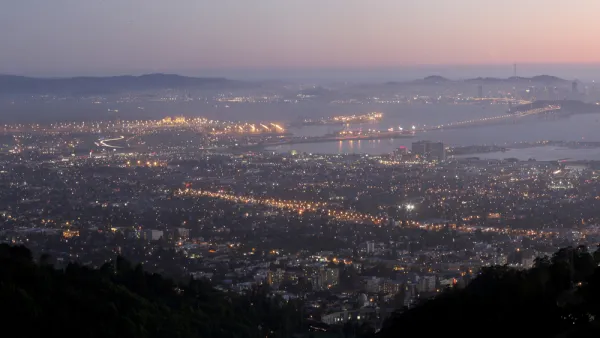
Can a Single Regional Planning Agency Fix What Ails the Bay Area?
The potential to address the housing and transportation issues of the Bay Area by a single regional agency will be addressed this week.
Second Largest Bikeshare in U.S. will be Bay Area's by 2017
Bay Area Bike Share will grow from 700 to 7,000 bikes by 2017 after the expansion proposal was approved by a unanimous vote of the Metropolitan Transportation Commission. It is a regional, not a city program, though most usage is in San Francisco.
Bay Area Bike Share Poised to Grow from 700 to 7,000 Bikes
The regional system would expand to the the East Bay cities of Berkeley, Oakland and Emeryville. Bikes would be added in San Jose and San Francisco.

Planetizen Federal Action Tracker
A weekly monitor of how Trump’s orders and actions are impacting planners and planning in America.

California plans to bury El Niño’s downpour
If the state plays its cards right, it may be able to store a billion acre-feet of El Niño’s water in aquifers.

Desperate measures: Advocates weigh draining Lake Powell to fill Colorado River
Draining the reservoir could reduce evaporation losses by a couple hundred thousand acre-feet.

Los Angeles just elected an urban planner as its mayor
Transportation analysts are optimistic that Raman will be more aggressive in addressing transit issues than Bass.

Mamdani’s pied-à-terre tax survives legal challenge
A panel of judges found that the plaintiffs failed to demonstrate injury as a result of New York City's implementation of the tax.

Eastern Nebraska is running out of electricity
Data centers and electrification are straining eastern Nebraska’s grid, throttling economic development.

FREE Course: Walkable City 1: Why Walkability?
After describing his path towards focusing on walkability as the essence of good planning, Jeff Speck marches through his five principal reasons for making more walkable places.
Reinventing Malls: Planning Alchemy—Turning Gray Fields Into Gold
The course focuses on the opportunities and imperatives that shape reinvention of mall sites.

City of Rosemead
Rutgers University, Edward J. Bloustein School of Planning and Public Policy
One Hundred Miles
University of Michigan School for Environment and Sustainability (SEAS)
Hunter College, City University of New York (CUNY)
The Architects Foundation
City of Cambridge
Montrose County
The Pocatello Development Authority