Developers on Long Island are hoping to build transit-oriented developments as a way of keeping young residents on the island and increasing the amount of affordable housing. But some local opposition is standing in the way.


Developers had hoped to build 490 housing units on a plot approved for just 109, which has gradually become more of a controversy amongst locals.
"[S]ince the largely positive first public hearing on the development last March, at which more than 50 people testified, vociferous camps have emerged both for and against the development. Supporters say this kind of project is the future of development on Long Island. The opposition warns of too much density, overcrowding in schools and traffic congestion.
The Huntington town board is scheduled to consider the issue again on Tuesday, which could be contentious if the events of a Sept. 7 board meeting are anything to go by. Although that meeting did not have the AvalonBay project on its schedule, 50 people showed up with the intention of discussing it. At one point a pro-development demonstration was held outside; half an hour later an anti-AvalonBay rally was held."
Read the full story: A Rift Over Transit-Housing Plan

Plans for TOD Housing at Berkeley BART Station
The city is behind plans to turn parking lots around the North Berkeley BART station into much-needed housing.
Building in Affordability
Rebecca Cohen and Emily Salomon of the Center for Housing Policy examine existing policy tools to preserve and expand affordable housing near planned transit stations.
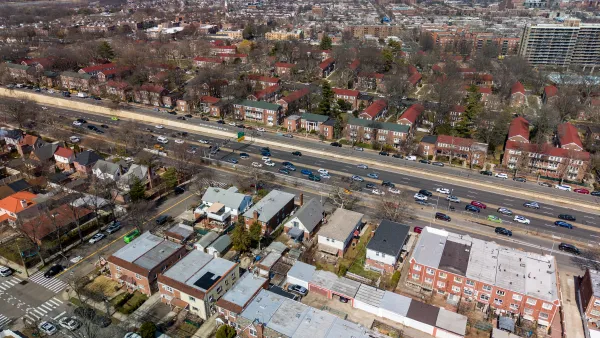
Long Island public housing applicants face longest wait times in America
Applicants to large, medium and small housing authorities in Long Beach all face exceptionally long waiting periods.

Planetizen Federal Action Tracker
A weekly monitor of how Trump’s orders and actions are impacting planners and planning in America.

California plans to bury El Niño’s downpour
If the state plays its cards right, it may be able to store a billion acre-feet of El Niño’s water in aquifers.

Desperate measures: Advocates weigh draining Lake Powell to fill Colorado River
Draining the reservoir could reduce evaporation losses by a couple hundred thousand acre-feet.

Mamdani’s pied-à-terre tax survives legal challenge
A panel of judges found that the plaintiffs failed to demonstrate injury as a result of New York City's implementation of the tax.

Eastern Nebraska is running out of electricity
Data centers and electrification are straining eastern Nebraska’s grid, throttling economic development.

Seattle passes record-breaking transit services expansion
Proposition 1 will double the city’s transit tax to add 95,000 more bus trips and preserve 180,000 bus trips annually.

FREE Course: Walkable City 1: Why Walkability?
After describing his path towards focusing on walkability as the essence of good planning, Jeff Speck marches through his five principal reasons for making more walkable places.
Reinventing Malls: Planning Alchemy—Turning Gray Fields Into Gold
The course focuses on the opportunities and imperatives that shape reinvention of mall sites.

City of Rosemead
Rutgers University, Edward J. Bloustein School of Planning and Public Policy
One Hundred Miles
University of Michigan School for Environment and Sustainability (SEAS)
Hunter College, City University of New York (CUNY)
The Architects Foundation
City of Cambridge
Montrose County
The Pocatello Development Authority