In the last 2 years, New York's Broadway has given up 3.5 miles of traffic lanes and parking to bike lanes and pedestrian access, and gained a significant improvement in congestion and accident rates.


"[New York City Transportation Commissioner] Janette Sadik-Khan contends that the north-south avenues and the east-west streets work better without a large volume of conflicting traffic on Broadway. Traffic accidents have decreased, according to transportation officials. Injuries are down. Nearby avenues in Midtown are said to be less backed up. 'We are accommodating thousands of more pedestrians,' said Sadik-Khan. Sidewalks have been extended into what was street space. In some places, parking lanes have been established in the middle of the street."
Thanks to Renee Brutvan
Read the full story: Pedestrian-oriented Broadway increasingly shunned by drivers
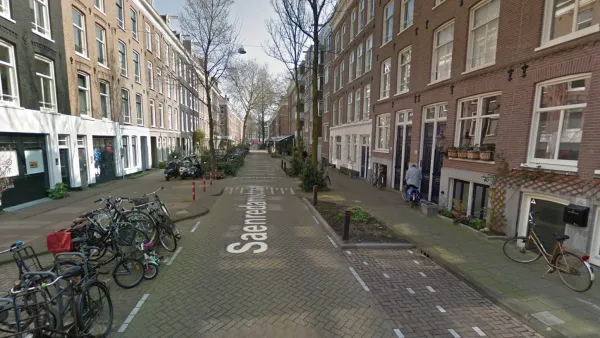
Watch: How to Remove Thousands of Parking Spaces
What the city of Amsterdam will gain by removing cars from on-street parking space.

No More Parking Minimums in Hartford
Earlier this month, the Hartford Planning and Zoning Commission voted unanimously on a revised zoning code that lets builders forgo parking citywide.
D.C. Limits Parking to Promote Bicycling and Transit
As part of a broader effort to encourage less vehicular traffic city-wide, D.C. is expanding permit parking and reducing on-street parking in some of the city's most crowded neighborhoods. Not all are happy with the changes, reports Tim Craig.

Planetizen Federal Action Tracker
A weekly monitor of how Trump’s orders and actions are impacting planners and planning in America.

Eastern Nebraska is running out of electricity
Data centers and electrification are straining eastern Nebraska’s grid, throttling economic development.

Washington state to charge fee to drivers with fuel-efficient cars
Revenue from the fee will go towards supporting the state’s highways.

Instead of building new housing, LA developers are turning mansions into mega-mansions
In the richest areas, the number of houses valued at $30 million with demolition permits has skyrocketed since 2018.

Illinois considers spending $1 billion in taxpayer money on data center
A quantum computing campus and data center are currently under construction in Chicago.

As development costs rise, Boston moves to lessen affordable housing requirements
The Boston Zoning Commission and the City Council still need to approve Boston Mayor Michelle Wu’s proposed changes

FREE Course: Walkable City 1: Why Walkability?
After describing his path towards focusing on walkability as the essence of good planning, Jeff Speck marches through his five principal reasons for making more walkable places.
Reinventing Malls: Planning Alchemy—Turning Gray Fields Into Gold
The course focuses on the opportunities and imperatives that shape reinvention of mall sites.

City of Charlotte
City of Rosemead
Rutgers University, Edward J. Bloustein School of Planning and Public Policy
University of Michigan School for Environment and Sustainability (SEAS)
Hunter College, City University of New York (CUNY)
The Architects Foundation
University District Partnership
City of Cambridge
The Pocatello Development Authority