With infrastructure aging, technology is increasingly relied upon to assess the safety of bridges. Many places are finding that simple monitoring devices can help save money.


"A recent case study about a bridge in Monmouth County, N.J., illustrates how evolving bridge sensor technology now offers tools to far more accurately assess the structural health of existing bridges, and enables public officials to make more informed safety decisions about bridge capacity.
In effect, bridge sensor technology is a multistep process that begins with the creation of a 3-D structural model which takes into account the original design, and the accumulated modifications, repairs and upgrades made to the bridge over time, together with the areas of deterioration. Then strain sensors installed on critical structural members further refine the model. When the calibration is complete and the model confirmed as "true" to the real bridge, sequential tests with different types of loads provide data to tell engineers what the prognosis is with far greater accuracy."
Though some of the cost savings are small, the gradual upkeep of bridges rather than major overhauls helps to spread those costs over time and prevent dangerous accidents.
Read the full story: Technology Tells Whether Bridges are "Dead or Alive"

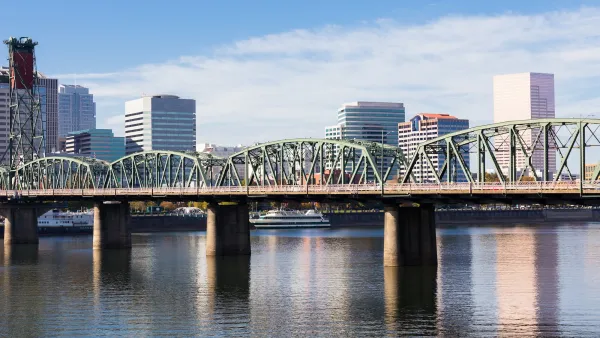
Federal agencies give go-ahead to I-5 Columbia River bridge project
The next few months will clarify whether the massive bridge replacement project will secure the funding to move forward as planned.

Thrift stores, public libraries and genderless bathrooms: How public amenities become trans infrastructure
Amenities like ample public transit, affordable retail and non-gendered bathroom spaces can make cities more safe and welcoming for transgender residents — and everyone else.

How urban design can deter crime
Well-designed public spaces and good lighting can prevent crime and make residents feel safer.

Planetizen Federal Action Tracker
A weekly monitor of how Trump’s orders and actions are impacting planners and planning in America.

Amtrak, CN end decades-long dispute with eight-year agreement
The new operating agreement establishes an updated framework for the companies to work together, including processes to resolve disputes.

Judges permit Denver to divert 77,000 acre feet from the Colorado River for reservoir expansion
Overuse and climate change have caused the Colorado River’s water levels to plummet.

Atlanta City Council unanimously backs $3.5 billion Beltline light rail project
The resolution was drafted after Atlanta Mayor Andre Dickens pulled support for the Atlanta Streetcar extension last year.

SEPTA to bring nearby frequent transit to over 1 million new riders as part of decade-long plan
The agency's Accelerate plan will also bring frequent transit to twice the amount of jobs that are currently located near it.

NYC plants over 18,000 trees, the most new foliage in a decade
Many of the trees were planted in communities vulnerable to extreme heat.

FREE Course: Walkable City 1: Why Walkability?
After describing his path towards focusing on walkability as the essence of good planning, Jeff Speck marches through his five principal reasons for making more walkable places.
Reinventing Malls: Planning Alchemy—Turning Gray Fields Into Gold
The course focuses on the opportunities and imperatives that shape reinvention of mall sites.

City of Wisconsin Rapids
Harvard University Graduate School of Design
KFH Group Inc.
The Architects Foundation
University of Cincinnati Online
The Pocatello Development Authority
The Urban Renewal Agency of the City of Pocatello