Urban Omnibus talks with Swoon, a Brooklyn-based street artist whose work is intended to engage constructed environments.


Cityscapes have played a major part in her work, and she is now working with a group of artists, builders, architects and engineers to help build homes and community spaces in Haiti.
"Urban Omnibus: Let's start with the city street and the relationship between the conditions of inspiration, production and display. What is the difference to you between creating for a canvas versus for a city wall? Does the distinction change the audience, the message, or both?
Swoon: Almost the only difference for me in creating for a protected indoor setting versus creating for outside is a practical one. Things have to be smaller and faster to put up outside, more streamlined in their design. If I am cutting paper to create a portrait, and I find myself making really large cuts, I know it's going to be a lot harder to paste up quickly. Or, if I am making something huge, I know that it will have trouble finding itself within the small architectural niches of a more dense urban area. Because my way of working and creating portraits evolved entirely in dialogue with city walls, these practical considerations, as well as thoughts about how people relate to the portraits when they see them on the street, are a big part of forming what you see, whether I am making a gallery installation, or working on the street. The creative process is very quiet compared to the execution and the life of the piece. And the conditions of inspiration? That's just day to day."
Read the full story: Swoon: The City Created, Built, Broken and Rebuilt
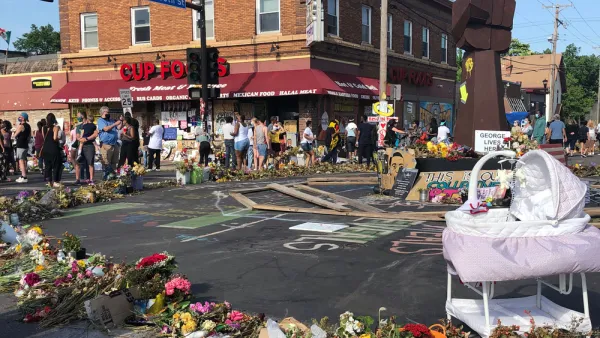
The Racial Reckoning in Public Spaces
Following George Floyd’s murder in 2020, there was an explosion of anti-racist street art across the country. “When we allow ourselves to release our emotions, oftentimes what is produced out of that is art.”
Art Leads a Miami Neighborhood's Comeback
After a decade of establishing itself on the global art calendar, the "once-forlorn slab of Miami called Wynwood" is now a year-round must-see destination.
Urban Art Brightens Dull Sections of Toronto
A variety of unsanctioned urban art projects are scattered throughout Toronto, bringing life and energy to otherwise underused spaces.

Planetizen Federal Action Tracker
A weekly monitor of how Trump’s orders and actions are impacting planners and planning in America.

California plans to bury El Niño’s downpour
If the state plays its cards right, it may be able to store a billion acre-feet of El Niño’s water in aquifers.

Desperate measures: Advocates weigh draining Lake Powell to fill Colorado River
Draining the reservoir could reduce evaporation losses by a couple hundred thousand acre-feet.

Housing is the top priority of Seattle’s sole new councilmember
Jenks campaigned on building 1,000 new units of affordable housing.

New tax cuts may slash $1.5 billion in funding for Miami transit, public parks
Amendment 3 will save Miami-Dade homeowners $2,700 in 2028.

Arizona, Wisconsin, Pennsylvania hope to finally advance climate goals post-midterms
The three states have spent years under Republican or divided control.

FREE Course: Walkable City 1: Why Walkability?
After describing his path towards focusing on walkability as the essence of good planning, Jeff Speck marches through his five principal reasons for making more walkable places.
Reinventing Malls: Planning Alchemy—Turning Gray Fields Into Gold
The course focuses on the opportunities and imperatives that shape reinvention of mall sites.

City of Rosemead
Rutgers University, Edward J. Bloustein School of Planning and Public Policy
One Hundred Miles
University of Michigan School for Environment and Sustainability (SEAS)
Hunter College, City University of New York (CUNY)
The Architects Foundation
City of Cambridge
Montrose County
The Pocatello Development Authority