Despite its reputation as a planner's dream, the city of Vancouver has incredibly high housing prices, which is part of the reason New Geography's Steve Lafleur calls it a middle class nightmare.


Lafleur looks at the demand for housing and real estate in Vancouver, and how the city's urban planning policies have ushered in an era of compact urbanism. But with what some might see as gains, the city's housing stock has become increasingly unaffordable for most middle class workers.
"In addition to smart growth policies, Vancouver also has very stringent inclusionary zoning laws. Inclusionary zoning requires developers to provide a certain number of affordable housing units in any given development. This policy might seem to make the city more affordable, but it functions exactly like rent control. Those fortunate enough to find spaces in the affordable housing units pay less, but the subsidized rent is made up for by higher rent in adjacent units. In a study of inclusionary zoning in California cities, Benjamin Powell and Edward Stringham from the Department of Economics at San Jose State University found that inclusionary zoning imposes an additional $33,000-$66,000 cost on adjacent market rate units.
There have been some recent policy initiatives that may reduce the cost of housing marginally. In 2004, the city amended its zoning code to permit secondary suites throughout the city. Secondary suites are subdivided units of owner occupied homes that are used as rental units. This zoning change brought tens of thousands of relatively low cost units into the market. There are currently 120,000 secondary suites in the province."
Thanks to The Overhead Wire
Read the full story: Vancouver: Planner’s Dream, Middle Class Nightmare
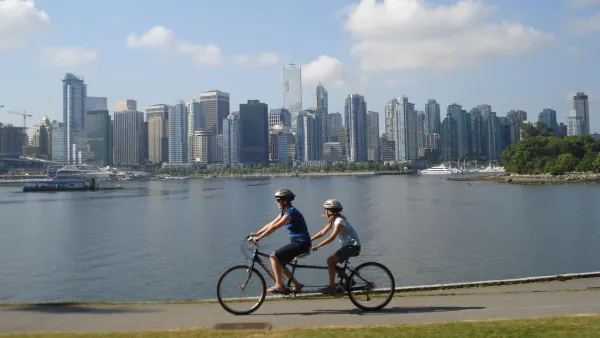
Vancouver Again Raises its Empty Homes Tax
The Vancouver Empty Homes Tax will soon be three times as high as it was when adopted in 2017.
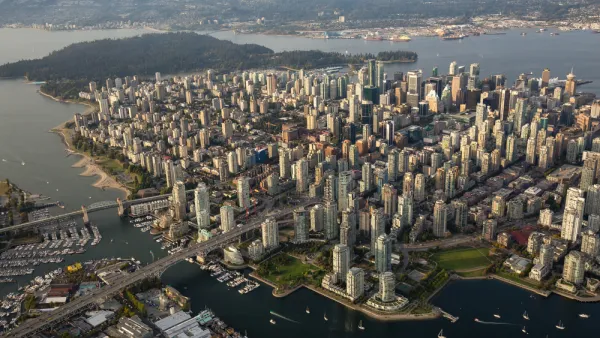
Vancouver's New 10-Year Housing Strategy Focuses on Rentals
Vancouver is famous for high-rises and a decidedly urban quality of life, but housing prices are still skyrocketing. A new ten-year housing strategy proposes a few drastic measures to rebalance the market's scales.
Analysis: Vancouver Housing Affordability Worsens Despite Foreign Buyer Tax
The trends in the Vancouver housing market have reverted back to normal, after a foreign buyers tax that went into effect in 2016 had an initial effect on parts of the market.

Planetizen Federal Action Tracker
A weekly monitor of how Trump’s orders and actions are impacting planners and planning in America.

California plans to bury El Niño’s downpour
If the state plays its cards right, it may be able to store a billion acre-feet of El Niño’s water in aquifers.

Desperate measures: Advocates weigh draining Lake Powell to fill Colorado River
Draining the reservoir could reduce evaporation losses by a couple hundred thousand acre-feet.

US buildings threatened, destroyed by fires set to triple by 2060
Researchers found a high fire risk for socioeconomically vulnerable neighborhoods in the American West.

LA residents may be allowed to paint their own crosswalks
Councilwoman Katy Yaroslavsky put out a motion instructing the Los Angeles Department of Public Transportation to study the feasibility of allowing volunteers to paint crosswalks.

Dallas moves to overhaul its zoning code
The city's zoning reform will allow more multi-family and mixed-use developments.

FREE Course: Walkable City 1: Why Walkability?
After describing his path towards focusing on walkability as the essence of good planning, Jeff Speck marches through his five principal reasons for making more walkable places.
Reinventing Malls: Planning Alchemy—Turning Gray Fields Into Gold
The course focuses on the opportunities and imperatives that shape reinvention of mall sites.

City of Rosemead
Rutgers University, Edward J. Bloustein School of Planning and Public Policy
One Hundred Miles
Hunter College, City University of New York (CUNY)
The Architects Foundation
University of Cincinnati Online
City of Cambridge
Montrose County
The Pocatello Development Authority