Columnist Roger K. Lewis says Washington D.C. has a lot to learn from New York City in terms of reusing old and outdated infrastructure.


Lewis argues that D.C. needs to look at the success of New York City's High Line park as it tries to repurpose its closed-off trolley tunnels.
"Most cities, including Washington, have defunct infrastructure leftovers. The District recently issued a Request for Proposals to develop new uses for 3,000 linear feet of abandoned trolley car tunnels built in 1948 below Dupont Circle and alongside the Connecticut Avenue NW underpass. Trolley operations ended in 1962, and the tunnels were sealed in 1964.
This is not the first attempt at revitalizing the Dupont Circle trolley tunnel. In 1995-96, the city leased tunnel space to a developer who tried to make a go of an underground food court. It went out of business in a year. With dozens of aboveground cafes and restaurants in the Dupont Circle neighborhood, this was no surprise. Why descend into a sunless tunnel to dine?"
Read the full story: D.C. could learn a lot from N.Y. on transforming obsolete infrastructure
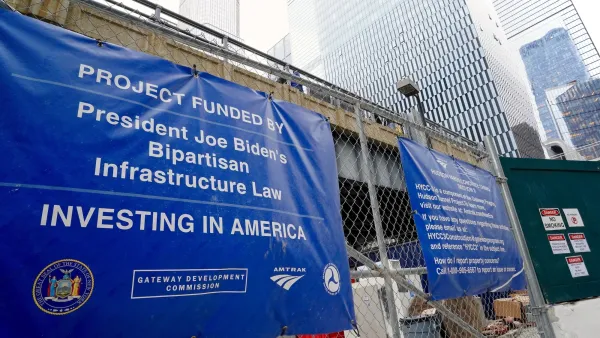
NYC-NJ Gateway Tunnel Project to Stop Work Next Week if DOT Doesn’t Release Funding
The federal government hasn’t released funding frozen during last October’s government shutdown.
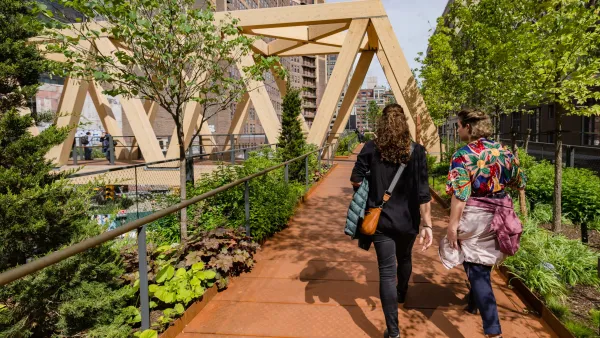
High Line-Moynihan Connector Opens in New York City
Two footbridges now link the High Line park to the most recent expansion of the Penn Station complex, the Moynihan Train Hall.
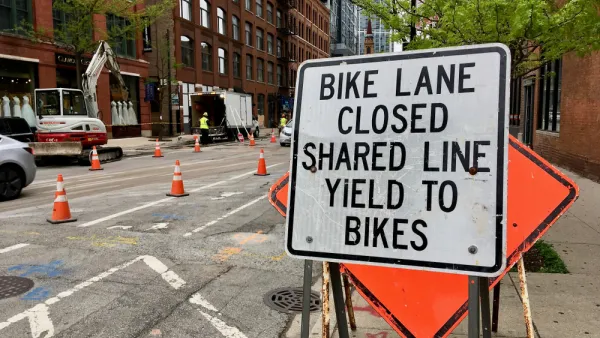
Rebuilding From the Failures of Vision Zero
Vision Zero pledges in New York City and Washington, D.C. have failed to slow the carnage on streets and roads—traffic fatalities are only increasing. It's time to start over.

Planetizen Federal Action Tracker
A weekly monitor of how Trump’s orders and actions are impacting planners and planning in America.

California plans to bury El Niño’s downpour
If the state plays its cards right, it may be able to store a billion acre-feet of El Niño’s water in aquifers.

Desperate measures: Advocates weigh draining Lake Powell to fill Colorado River
Draining the reservoir could reduce evaporation losses by a couple hundred thousand acre-feet.

US buildings threatened, destroyed by fires set to triple by 2060
Researchers found a high fire risk for socioeconomically vulnerable neighborhoods in the American West.

LA residents may be allowed to paint their own crosswalks
Councilwoman Katy Yaroslavsky put out a motion instructing the Los Angeles Department of Public Transportation to study the feasibility of allowing volunteers to paint crosswalks.

Dallas moves to overhaul its zoning code
The city's zoning reform will allow more multi-family and mixed-use developments.

FREE Course: Walkable City 1: Why Walkability?
After describing his path towards focusing on walkability as the essence of good planning, Jeff Speck marches through his five principal reasons for making more walkable places.
Reinventing Malls: Planning Alchemy—Turning Gray Fields Into Gold
The course focuses on the opportunities and imperatives that shape reinvention of mall sites.

City of Rosemead
Rutgers University, Edward J. Bloustein School of Planning and Public Policy
One Hundred Miles
Hunter College, City University of New York (CUNY)
The Architects Foundation
University of Cincinnati Online
City of Cambridge
Montrose County
The Pocatello Development Authority