Boston uses the threat of eminent domain to force a developer to build on a site that's become an eyesore.


Eminent domain is often an act of government taking property from a private landowner for the public good. In this case, Boston Mayor Thomas Menino accuses developer Steven Roth of Vornado Realty Trust of turning a landmark site into urban blight.
The property at issue used to hold the original Filene's Basement. It closed in 2007. Roth's Vornado group started demolition of the site in 2008 for a $700 million mixed-use development, but the recession stalled financing. The site has remained a vacant lot with a couple of partially torn-down buildings.
In a letter to Roth, Mayor Menino wrote "[b]light kills jobs by destroying an area's appeal to businesses and consumers. Inflicting pain on people, businesses and communities to inflate the return to your enormously profitable company is reprehensible."
One property law expert doubts Menino's threats to use eminent domain to takeover the site will work, but the idea has gotten a lot of popular support from Boston residents who want to see something happen to what used to be a signature property.
Read the full story: Mayor Battles Vornado in Boston

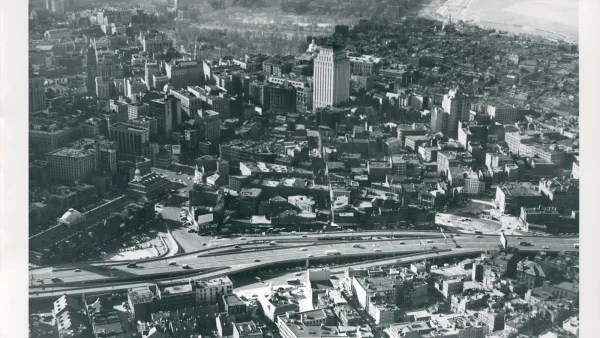
Watch: The Dark Side of Eminent Domain
In cities like Boston, the government’s right to take private property displaced residents and destroyed vulnerable neighborhoods and communities.
Green Neighborhood Plan Has Residents Riled
As Mayor Bloomberg moves forward with an eco-friendly redevelopment for the crumbling Willets Point neighborhood, locals feel pushed aside and complain that eminent domain is out of control.
Is eminent domain necessary for revitalizing cities?
Planners are split on eminent domain—one group believes it’s a critical component of planning since it allows them to implement plans more quickly. Others believe eminent domain does more to destroy urbanism than build it up. I’ve weighed in on it numerous times, including this commentary published by Planetizen.

Planetizen Federal Action Tracker
A weekly monitor of how Trump’s orders and actions are impacting planners and planning in America.

Chicago breaks ground on $3 billion megadevelopment
The new neighborhood, titled Foundry Park, will one day host 3,700 residences.

This MA town is drowning in its own sewage — and residents like it that way
Susan Murcott, a waste water expert, said if Carlisle didn't address their leaking sewage, the problem could turn “deadly.”

Iowa taxpayers are paying thousands to clean manure out of their water
While the Clean Water Act makes states responsible for regulating factory farms that discharge pollutants, Iowa has turned a blind eye to the polluting farms.

Amtrak cuts ribbon on Seattle Airo maintenance facility
The $250 million, nearly 100,000-square-foot building can house an entire Cascades Airo trainset.

To power data centers, Google seeks autonomous control of thousands of homes’ electricity
The tech company has signed a deal to indirectly pay Mid-Atlantic residents to reduce their power demand when the grid is strained.

FREE Course: Walkable City 1: Why Walkability?
After describing his path towards focusing on walkability as the essence of good planning, Jeff Speck marches through his five principal reasons for making more walkable places.
Reinventing Malls: Planning Alchemy—Turning Gray Fields Into Gold
The course focuses on the opportunities and imperatives that shape reinvention of mall sites.

City of Rosemead
Rutgers University, Edward J. Bloustein School of Planning and Public Policy
One Hundred Miles
The Architects Foundation
University of Cincinnati Online
Montrose County
The Pocatello Development Authority
The Urban Renewal Agency of the City of Pocatello