A $5.35 billion plan to build a light rail system in Honolulu, Hawaii, is on rocky ground as the state's governor has joined the opposition movement.


"Honolulu's planned heavy rail transit system, which would run 20.2 miles between East Kapolei and Ala Mona Center by 2019, is expected to serve more than 100,000 daily riders along its 21-station elevated guideway. That is, if the city is able to secure a federal New Starts Full Funding Grant Agreement as planned in 2011, and as long as it is capable of maintaining adequate tax revenue to pay for the line.
That's where Hawaii Governor Linda Lingle (R), now in the last year of her second term, and Honolulu Mayor Mufi Hannemann (D), in the second year of his second term, strongly disagree."
Voters have already approved the plan, and the Federal Transit Administration has begun preliminary engineering. But gathering federal funding for the plan ultimately relies on the governor, and she is currently debating the economics of such an expensive project.
Read the full story: It's Governor Lingle versus Mayor Hannemann on Honolulu Rail Project

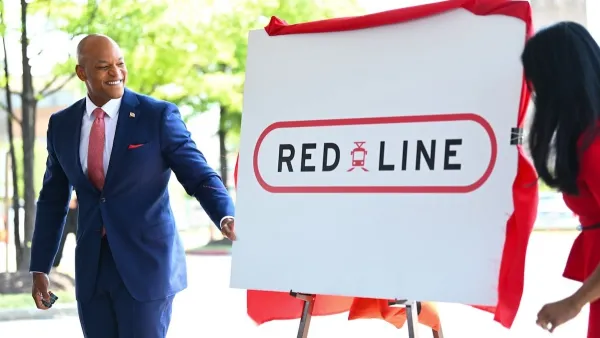
Feds Pause Baltimore Red Line Permits
The MTA says it is committed to continuing work on the light rail project, but the pause signals a potential shift in federal funding for the east-west line.
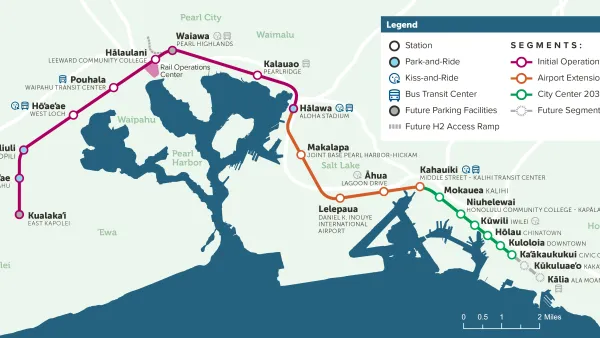
Skyline Rail, Now Serving Honolulu
In a historic day for public transit, Skyline Rail, a project once deemed the worst transit project in the United States due to extreme cost overruns and construction delays, finally opened to the public at the end of June.

Honolulu Light Rail to Open in June
The city’s first light rail line will finally begin service after more than a half century of planning.

Planetizen Federal Action Tracker
A weekly monitor of how Trump’s orders and actions are impacting planners and planning in America.

The state-sanctioned urbicide of Austin
People don’t kill cities. Freeways do.

Colorado’s Largest Data Center Could Rise Next to Homes — Without a Public Hearing
The proposed campus would consume 11 times the power of Denver International Airport; as it has across the country, opposition mounts.

Judges permit Denver to divert 77,000 acre feet from the Colorado River for reservoir expansion
Overuse and climate change have caused the Colorado River’s water levels to plummet.

Amtrak, CN end decades-long dispute with eight-year agreement
The new operating agreement establishes an updated framework for the companies to work together, including processes to resolve disputes.

Raised interest rates may kill financially vulnerable construction projects
The chief economist at ConstructConnect warns that if construction project owners are negatively impacted by the raised rates, it could result in delayed payments to contractors.

FREE Course: Walkable City 1: Why Walkability?
After describing his path towards focusing on walkability as the essence of good planning, Jeff Speck marches through his five principal reasons for making more walkable places.
Reinventing Malls: Planning Alchemy—Turning Gray Fields Into Gold
The course focuses on the opportunities and imperatives that shape reinvention of mall sites.

KFH Group Inc.
Greater Baltimore Committee
Eagle County Government
The Architects Foundation
University of Cincinnati Online
The Pocatello Development Authority
The Urban Renewal Agency of the City of Pocatello