Detroit revitalizes urban farming to replace dying industry.


As a city still haunted by the death of its auto and manufacturing industries, Detroit is looking for any alternatives to help it regrow. The answer to its economic woes, however, may require a little digging into its agricultural past.
Before becoming the bustling Motown, Detroit was a stretch of farmland. Today, it hopes to trade in abandoned buildings for rich soil.
"There's so much land available, and it's begging to be used," said Michael Score, president of the Hantz Farms, which is buying up abandoned sections of the city's 139-square-mile landscape and plans to transform them into a large-scale commercial farm enterprise. "Farming is how Detroit started," Score said, "and farming is how Detroit can be saved."
Can urban gardening put Detroit back on the map?
Thanks to Akshali Gandhi
Read the full story: Detroit Cultivates Urban Farm Initiative

From Motor City to Garden City
Detroit may be struggling economically, but community groups and citizen activists are keeping the city vibrant with a wide variety of urban farming projects throughout the shrinking city.
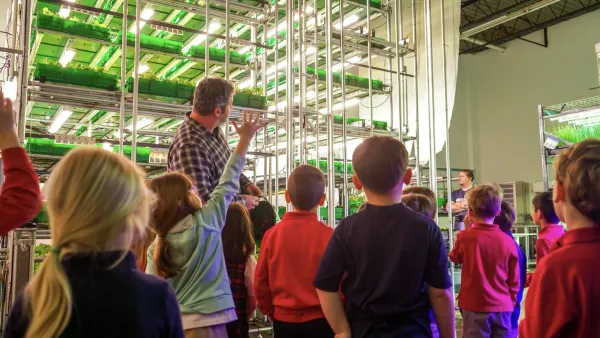
A Multimillion Dollar Virginia Company is Turning Empty Office Buildings Into Farms
Area 2 Farms envisions a world where 90% of the U.S. population lives within 10 miles of an indoor farm.

Urban Farming Addressing Hunger (and More) in Pittsburgh
Urban farming provides opportunities to increase food security in addition to other benefits.

Planetizen Federal Action Tracker
A weekly monitor of how Trump’s orders and actions are impacting planners and planning in America.

California plans to bury El Niño’s downpour
If the state plays its cards right, it may be able to store a billion acre-feet of El Niño’s water in aquifers.

Chicago breaks ground on $3 billion megadevelopment
The new neighborhood, titled Foundry Park, will one day host 3,700 residences.

One of Denver’s busiest corridors to gain BRT
The project will span 18 miles and contain 74 bus rapid transit stations.

275,000 bus trips are at stake on Seattle's ballot
If passed, the Seattle Transit Measure would trigger a 0.3% sales tax and raise an average of $138 million per year to maintain and expand Seattle’s bus services.

Texas may pay Israeli company billions to ease water woes
Texas awarded IDE Technologies the contract for its Harbor Island project, which is slated to become the Western Hemisphere's largest desalination plant.

FREE Course: Walkable City 1: Why Walkability?
After describing his path towards focusing on walkability as the essence of good planning, Jeff Speck marches through his five principal reasons for making more walkable places.
Reinventing Malls: Planning Alchemy—Turning Gray Fields Into Gold
The course focuses on the opportunities and imperatives that shape reinvention of mall sites.

City of Rosemead
Rutgers University, Edward J. Bloustein School of Planning and Public Policy
One Hundred Miles
Hunter College, City University of New York (CUNY)
The Architects Foundation
University of Cincinnati Online
City of Cambridge
Montrose County
The Pocatello Development Authority