Michael S. Thompson of the Chicago Honey Co-op discusses his urban beekeeping operation and how it provides jobs to otherwise hard-to-employ people.


"We chose to raise this particular animal in an older American city because of the abundant nectar forage left over from farming here in the last two centuries and the addition of millions of city-planted shade trees. Locating the bee farm close to where we live and sell the products helps enormously in the reduced amount of travel time and heavy hauling needed for honey production. Also, under-used industrial parks abound in this postindustrial city, providing excellent opportunities for food production."
The program was initiated through a grant from the Illinois Department of Corrections, and provides work for recently released prisoners in Chicago.
Read the full story: Urban Honey

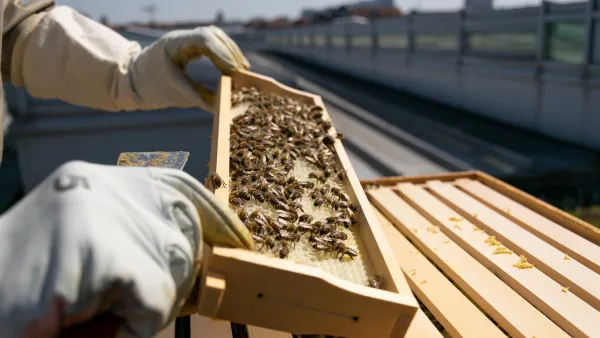
Urban Honeybees are ‘Having a Moment’ — but it’s not all Milk and Honey
The European honeybees kept by many businesses and schools often compete with local pollinator species.
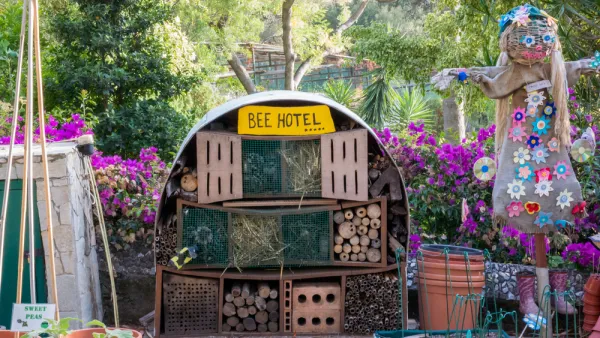
How Pollinators Fight Warming Cities
Researchers are starting to understand how urban bee populations can support healthy green spaces and reduce the urban heat island effect.
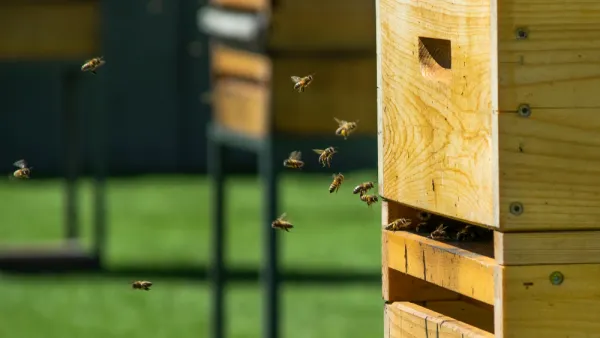
A Sweet Deal: Zoning for Honeybees
A Boston ordinance could make it easier for residents to take up urban beekeeping.

Planetizen Federal Action Tracker
A weekly monitor of how Trump’s orders and actions are impacting planners and planning in America.

California plans to bury El Niño’s downpour
If the state plays its cards right, it may be able to store a billion acre-feet of El Niño’s water in aquifers.

Chicago breaks ground on $3 billion megadevelopment
The new neighborhood, titled Foundry Park, will one day host 3,700 residences.

Want to study the Missouri River? Soon, you may need unanimous approval from 10 states
Legislation would require 10 governors’ permission to study or build projects moving water outside the basin.

Desperate measures: Advocates weigh draining Lake Powell to fill Colorado River
Draining the reservoir could reduce evaporation losses by a couple hundred thousand acre-feet.

This road in NYC is infamously dangerous — and Mamdani can't fix it
New York City's Ocean Parkway is known for reckless driving, but the power to implement safety measures lies with the state rather than the city.

FREE Course: Walkable City 1: Why Walkability?
After describing his path towards focusing on walkability as the essence of good planning, Jeff Speck marches through his five principal reasons for making more walkable places.
Reinventing Malls: Planning Alchemy—Turning Gray Fields Into Gold
The course focuses on the opportunities and imperatives that shape reinvention of mall sites.

City of Rosemead
Rutgers University, Edward J. Bloustein School of Planning and Public Policy
One Hundred Miles
Hunter College, City University of New York (CUNY)
The Architects Foundation
University of Cincinnati Online
City of Cambridge
Montrose County
The Pocatello Development Authority