Last Friday was Park(ing) Day 2009, a growing movement where city parking spaces are transformed into miniature parks as a comment on public space (and the lack thereof). Here's a glimpse into Seattle's version.


"Keith Harris of People's Parking Lot(s*) organized 15 mini-parks for an empty lot at Summit Avenue and East Pine Street in Capitol Hill (organizations that hosted parks, including Capitol Hill Housing and Seattle Arts and Lectures, are listed on his site). The collection of sites, called "Central Park," had a live d.j., an oversize Connect Four board, several participatory art projects and cupcakes. He also arranged an award ceremony at the conclusion of the event, the results of which are posted on his site (the grand prize went to the "air.stream" park by Signal to Noise Design).
Harris, a former structural engineer who will start a Ph.D. program this fall at University of Washington's College of Built Environments, said the day was meant to bring activity to the underutilized lot. "This is a hole in our community, so let's liven it up," he said."
Thanks to Eric Nusbaum
Read the full story: Re-Imagining Public Spaces on Park(ing) Day

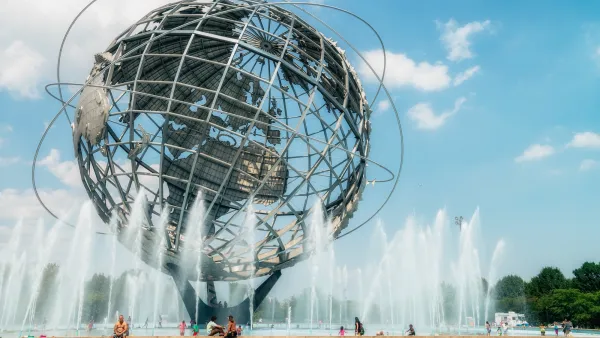
Historic Queens park is getting a $120M upgrade
The borough's largest park will undergo significant upgrades for accessibility, flood mitigation and historic preservation.
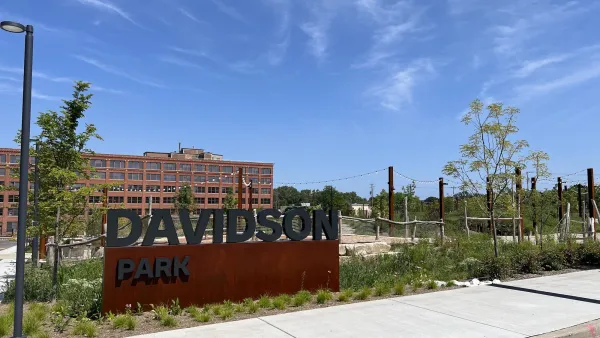
Harley-Davidson turned a Milwaukee parking lot into a green oasis
The park, adjacent to Harley-Davidson headquarters, doubles as stormwater retention infrastructure.
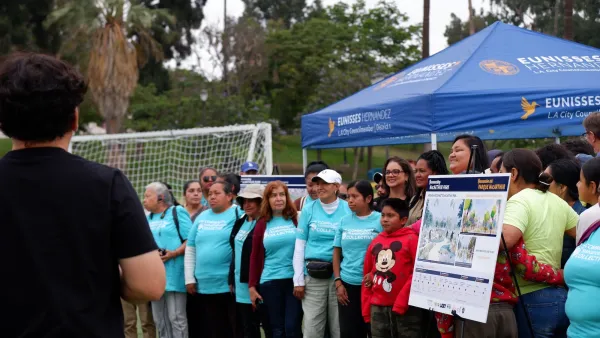
LA unveils plans to reconnect MacArthur Park
The construction of Wilshire Boulevard split the park in two in 1934.

Planetizen Federal Action Tracker
A weekly monitor of how Trump’s orders and actions are impacting planners and planning in America.

California plans to bury El Niño’s downpour
If the state plays its cards right, it may be able to store a billion acre-feet of El Niño’s water in aquifers.

Desperate measures: Advocates weigh draining Lake Powell to fill Colorado River
Draining the reservoir could reduce evaporation losses by a couple hundred thousand acre-feet.

After public outcry, Massachusetts city releases housing development tracker
Cambridge’s tracker currently shows 250 housing projects in various stages of development.

40 years after approval, Chicago breaks ground on new park
The park honors Jean Baptiste Point du Sable, the city’s first permanent non-native settler.

‘Hoodwinked:’ New Mexico bill aimed at microgrids paves way for data center development
In an interview with High Country News, Padilla said the legislation “ignited” New Mexico's economy.

FREE Course: Walkable City 1: Why Walkability?
After describing his path towards focusing on walkability as the essence of good planning, Jeff Speck marches through his five principal reasons for making more walkable places.
Reinventing Malls: Planning Alchemy—Turning Gray Fields Into Gold
The course focuses on the opportunities and imperatives that shape reinvention of mall sites.

City of Rosemead
Rutgers University, Edward J. Bloustein School of Planning and Public Policy
One Hundred Miles
Hunter College, City University of New York (CUNY)
The Architects Foundation
University of Cincinnati Online
City of Cambridge
Montrose County
The Pocatello Development Authority