Eight years after terrorists felled the World Trade Center towers in New York City, progress on rebuilding the site has been slow and mired in controversy.


"A glance at the World Trade Center site from Greenwich Street tells a lot about progress there: Eight years after the Twin Towers fell, a 10-foot-tall, barbed-wire fence still surrounds the 16-acre void in the heart of Lower Manhattan.
Squabbles over designs and funding have caused severe construction delays. With the exception of the SOM-designed 7 WTC, a 52-story tower completed in 2006, the only discernible progress has happened below street level, on a museum and memorial planned for the site."
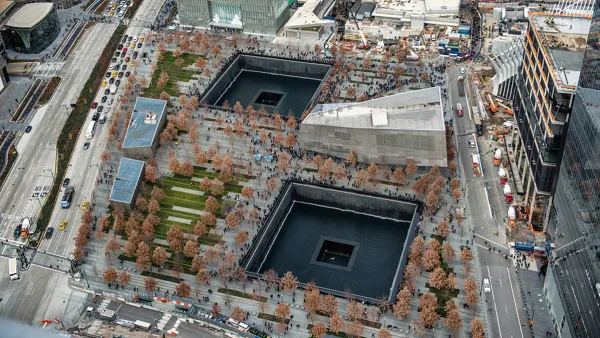
The memorial -- two pools -- are farthest along. The museum is also progressing, but above-ground work on the site of the former towers has not made much headway.
Read the full story: A Tale of Two Rebuilding Efforts at Ground Zero

How 9/11 Inspired Public Service as an Urban Planner
The account of how the terror and tragedy of 9/11 led an urban planner from working for a private consulting firm to working in the public sector.
Architect's Journey to Create September 11 Memorial
Architect Michael Arad design "Reflecting Absence" was chosen from 5,200 others. After navigating constant criticism and design hurdles, "Reflecting Absence," the memorial to victims of September 11, 2001, is 16 days from it's unveiling.
Political Skirmishes Delaying Ground Zero Construction
New York City's Ground Zero has sat as an empty hole for years. Though infrastructure work is underway, politics are holding the rebuilding back, according to this interview with New Yorker architecture critic Paul Goldberger.

Planetizen Federal Action Tracker
A weekly monitor of how Trump’s orders and actions are impacting planners and planning in America.

Amtrak, CN end decades-long dispute with eight-year agreement
The new operating agreement establishes an updated framework for the companies to work together, including processes to resolve disputes.

Judges permit Denver to divert 77,000 acre feet from the Colorado River for reservoir expansion
Overuse and climate change have caused the Colorado River’s water levels to plummet.

NYC DOT wants faster, more permanent street upgrades
The city is examining ways to build more concrete infrastructure without getting entangled in 'decades-long' projects.

'Something we’ve never seen before:' rising utility rates could strain city finances nationwide
Data centers, climate change and other factors have caused utility rates in the United States to increase by 38% since 2020.

Trump to overrule local leaders, lease millions of acres of America’s Pacific Island territories’ seafloors to mining companies
International law says that the Indigenous people of America’s territories have a right to prior and informed consent regarding projects that impact their countries.

FREE Course: Walkable City 1: Why Walkability?
After describing his path towards focusing on walkability as the essence of good planning, Jeff Speck marches through his five principal reasons for making more walkable places.
Reinventing Malls: Planning Alchemy—Turning Gray Fields Into Gold
The course focuses on the opportunities and imperatives that shape reinvention of mall sites.

Harvard University Graduate School of Design
KFH Group Inc.
Greater Baltimore Committee
The Architects Foundation
University of Cincinnati Online
The Pocatello Development Authority
The Urban Renewal Agency of the City of Pocatello