As the race for high speed rail stimulus dollars gets underway, international firms stand to gain the most benefit as few if any U.S. firms are capable of building the rolling stock the new systems will need.


"Companies based outside the U.S. have the most experience with high-speed rail, and several are jockeying to curry favor with California, Illinois, Florida and other leading candidates to receive funding.
Siemens USA, a subsidiary of Germany-based Siemens AG, has spent $76 million to expand a factory in Sacramento, Calif., where it builds rail cars. The company has already provided passenger vehicles for light-rail systems in San Diego, Denver and Salt Lake City, and it plans to hire more than 100 workers in the year or so ahead as it competes for stimulus-funded contracts."
Others -- from Canada to France to Spain -- are likely to gobble up the available contracts as projects get underway.
Read the full story: Race Is On to Grab Stake in Rail Effort


Las Vegas-to-L.A. High-Speed Rail Project Passes Another Hurdle
The segment between Rancho Cucamonga and the high desert town of Victorville received a key approval, with groundbreaking scheduled for later this year.
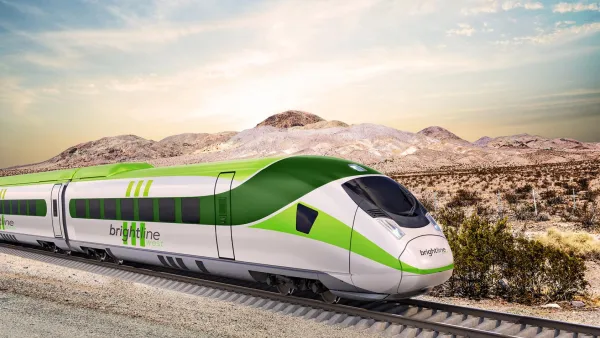
L.A.-Las Vegas High Speed Rail Could Break Ground Next Year
The privately funded train would shuttle passengers between Los Angeles and Las Vegas in half the time it takes to drive and could take 3 million vehicles off the road.

San Diego High-Speed Rail Plan Counts on Future Density
Despite slowing population growth statewide, officials believe the region will "grow into" the new rail system if cities promote dense development around transit stations.

Planetizen Federal Action Tracker
A weekly monitor of how Trump’s orders and actions are impacting planners and planning in America.

Amtrak, CN end decades-long dispute with eight-year agreement
The new operating agreement establishes an updated framework for the companies to work together, including processes to resolve disputes.

Judges permit Denver to divert 77,000 acre feet from the Colorado River for reservoir expansion
Overuse and climate change have caused the Colorado River’s water levels to plummet.

Philadelphia to invest $2 billion into upgrading city airports as PHL places last in customer satisfaction
Modernizations to Philadelphia's airports will include baggage system upgrades and a new automated parking garage guidance system.

The LA housing policies making developers turn away from the city
Despite LA’s housing shortage, developers say the city’s "mansion-tax" and pandemic-era policies make it an unappealing place to build housing.

New density bill would require 7 California cities to establish regional transit hubs
The bill would also require major cities in California to permit high-rise residential buildings.

FREE Course: Walkable City 1: Why Walkability?
After describing his path towards focusing on walkability as the essence of good planning, Jeff Speck marches through his five principal reasons for making more walkable places.
Reinventing Malls: Planning Alchemy—Turning Gray Fields Into Gold
The course focuses on the opportunities and imperatives that shape reinvention of mall sites.

City of Wisconsin Rapids
Harvard University Graduate School of Design
KFH Group Inc.
The Architects Foundation
University of Cincinnati Online
The Pocatello Development Authority
The Urban Renewal Agency of the City of Pocatello