The future of Paris has been laid out by ten teams of architects and planners. The ideas are broad, futuristic, and innovative, but few are likely to be realized.


"In more than a year of discussions, there have been some spectacular ideas and drawings by 10 teams of famous architects, drawn by the president's invitation to reimagine Paris as a city integrated with its suburbs and responsible in its environmental footprint.
Antoine Grumbach imagines Paris stretching along the Seine to Le Havre and the sea. Roland Castro, whose team included a sociologist and a philosopher, proposed a 250-acre park circled by skyscrapers in La Courneuve, one of the grimmest of the poor Paris suburbs. Richard Rogers plans rooftop gardens and parks built above railway lines. Yves Lion sees Paris sprouting with fields and forests, with citizens able to cultivate their own vegetable patches, an unfortunate similarity to the necessities of Soviet cities."
The plans of the 10 teams are typically ambitious, but some are calling them too unrealistic. French President Nicolas Sarkozy, who called for the submission of these "grand" plans has said he plans to push for some of the more practical elements explored in these plans.
The main problem, according to officials, is the 22-mile highway that rings the city and separates it from the suburbs. They want to blur the line and allow greater interaction between the city and the suburbs, both economically and environmentally.
Read the full story: A Paris Plan, Less Grand Than Gritty

How to Define the Suburban: HUD Survey Sheds New Light
A new HUD survey could help change the way the federal government defines the "suburban"—a notoriously tricky proposition.
The Death and Life of Great American…Suburbs?
Long considered beneath serious attention by design and planning elites, suburban settlements in the United States are emerging as key arenas to address crucial environmental, economic, and social issues.
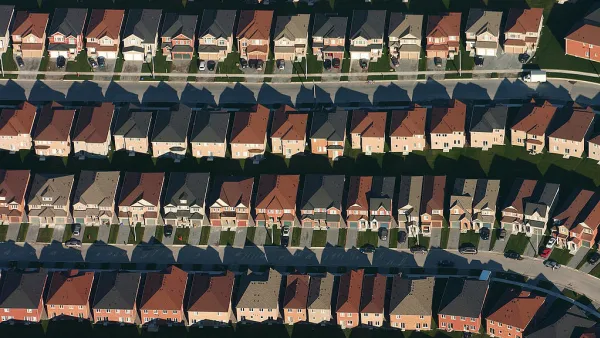
Opinion: The Old Visions of Suburbia Are an Anachronism
Low-density suburbs are on their way out, and the suburbs of the future will better address the present-day needs of the people living in them.

Planetizen Federal Action Tracker
A weekly monitor of how Trump’s orders and actions are impacting planners and planning in America.

The state-sanctioned urbicide of Austin
People don’t kill cities. Freeways do.

US to reduce Colorado River water deliveries to Mexico
A new Colorado Treaty amendment reduces Mexico’s Colorado River water allocation by 250,000 acre feet.

Nation's most wind-powered state turns to coal as data centers increase energy demand
For the first time in decades, Iowa has increased its generation of coal power.

NYC cools commuters with city's first rain garden above a bus stop
New York City officials say the plants in the rain garden can absorb 16 gallons of rainwater during heavy storms.

Brightline West’s future may rely on $6 billion federal loan
The company has until Nov. 2 to make a $400 million equity investment into its proposed high-speed rail line.

FREE Course: Walkable City 1: Why Walkability?
After describing his path towards focusing on walkability as the essence of good planning, Jeff Speck marches through his five principal reasons for making more walkable places.
Reinventing Malls: Planning Alchemy—Turning Gray Fields Into Gold
The course focuses on the opportunities and imperatives that shape reinvention of mall sites.

Eagle County Government
Harvard University Graduate School of Design
Nashville Planning Department
The Architects Foundation
University of Cincinnati Online
The Pocatello Development Authority
The Urban Renewal Agency of the City of Pocatello
Journal of the American Planning Association