USA Today reports on a growing trend of cities like Dallas and Seattle that are connecting their airports to their downtowns via rail.


"Airport rail links have long been popular in Europe and Asia. But only eight of the 20 largest U.S. airports, based on 2008 boardings, have rail service that drops passengers off within walking distance of the terminals: Atlanta, Chicago O'Hare, New YorkJohn F. Kennedy, San Francisco, Newark, Minneapolis, Boston and Philadelphia.
But a confluence of operational and economic factors have pushed the airport rail agenda forward in recent years despite opposition from taxi and bus proponents and fiscally conservative lawmakers.
With air traffic rising rapidly in recent years, airports are learning that simply building more parking lots and enlarging roadways aren't sustainable practices, [Matthew Coogan, director of New England Transportation Institute] says. Many U.S. airports have also embraced the green movement, budgeting more for programs that reduce their carbon footprint."
FULL STORY: More U.S. airports add rail service to downtown


Topics Planners Don't Often Think About, But Should
There are a number of areas of planning that offer planners a role, but are not necessarily at the front of our minds. At the Association of Collegiate Schools of Planning Conference, researchers shared results that can impact practice.
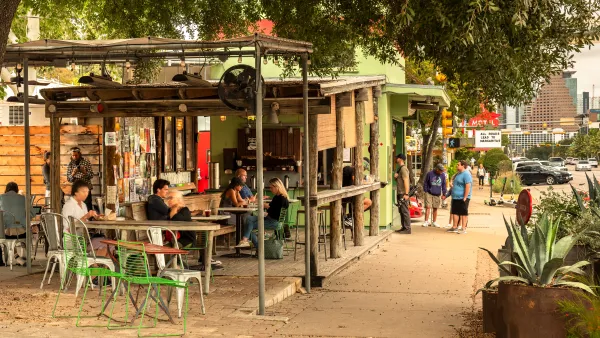
Large projects near Austin's light rail must include affordable housing
Elsewhere in the city, developers can pay into a city bank account for affordable housing rather than providing the required affordable units within their projects.

Budget constraints threaten light rail for Oregon, Washington’s new bridge
The current proposal includes only the infrastructure for the light rail, without funding for the train and tracks.

Planetizen Federal Action Tracker
A weekly monitor of how Trump’s orders and actions are impacting planners and planning in America.

The state-sanctioned urbicide of Austin
People don’t kill cities. Freeways do.

US to reduce Colorado River water deliveries to Mexico
A new Colorado Treaty amendment reduces Mexico’s Colorado River water allocation by 250,000 acre feet.

5 New England states march closer to 800 megawatt wind energy project
Securing federal approval for the project may be complicated under the Trump administration, which has historically been hostile towards domestic wind power.

Baltimore to break ground on $50 million Transit Priority Project
The project will bring faster bus trips, safer streets and better bike connections to Baltimore.

Airbnb launches $250 million 'last-dollar financing' housing accelerator, makes first investment in Austin
The company will put $6.4 million towards affordable housing development in Texas’ capital.

FREE Course: Walkable City 1: Why Walkability?
After describing his path towards focusing on walkability as the essence of good planning, Jeff Speck marches through his five principal reasons for making more walkable places.
Reinventing Malls: Planning Alchemy—Turning Gray Fields Into Gold
The course focuses on the opportunities and imperatives that shape reinvention of mall sites.

Eagle County Government
Harvard University Graduate School of Design
Nashville Planning Department
The Architects Foundation
University of Cincinnati Online
The Pocatello Development Authority
The Urban Renewal Agency of the City of Pocatello
Journal of the American Planning Association