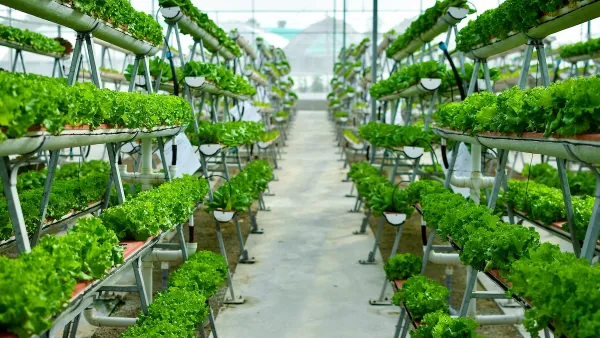
Miller-McCune talks with vertical farming innovator Dickson Despommier about why his idea is the future of food for cities and how it can go from blueprint to reality.


"By midcentury an estimated 80 percent of the world's population will live in urban areas. Feeding these new city dwellers will require creative ideas to reduce food miles and the associated energy use.
One solution may lie in Dickson Despommier's vertical farm - a 30-story crop powerhouse the size of a Manhattan block that, in theory, could produce enough food for 50,000 people."
Miller-McCune: "What are some of the biggest challenges with this endeavor?"
Dickson Despommier: "Coordinating all these systems into an engineering schema that allows each floor to act independently yet integrated into the flow of water, nutrient delivery, planting, growing and harvesting. All of that needs to be worked out. That's why we're advocating for a prototype vertical farm first to be located perhaps in a very gifted agricultural school's campus, next to a very large city, so you could use the city as your experimental playground for integrating versions of vertical farms into restaurants, schools and hospitals, etc."
Read the full story: Going Up? Farming in High-Rises Raises Hopes
Fish: the Future of Urban Farming
Cityscape Farms has developed a new technique for farming fish along with vegetables in combined urban food systems that allows them to farm in developed areas.
Vertical Farms Grow in Office Buildings
Office conversion is taking an agricultural turn.

Urban Farming Addressing Hunger (and More) in Pittsburgh
Urban farming provides opportunities to increase food security in addition to other benefits.

Planetizen Federal Action Tracker
A weekly monitor of how Trump’s orders and actions are impacting planners and planning in America.

Eastern Nebraska is running out of electricity
Data centers and electrification are straining eastern Nebraska’s grid, throttling economic development.

Move over, LA: St. Louis gears up for Olympics, invests millions in downtown redevelopment
The Missouri city will host the 2028 Olympic soccer group stage and knockout matches.

Dallas releases zoning code overhaul to officials
The drafted overhaul is over 400 pages long.

NYC renovations for dangerous, ‘mercilessly crammed’ street delayed until 2027
Construction was supposed to begin this fall.

San Diego’s Midway Rising project gets greenlight from city council
The project looks to become the largest affordable housing development in California's history.

FREE Course: Walkable City 1: Why Walkability?
After describing his path towards focusing on walkability as the essence of good planning, Jeff Speck marches through his five principal reasons for making more walkable places.
Reinventing Malls: Planning Alchemy—Turning Gray Fields Into Gold
The course focuses on the opportunities and imperatives that shape reinvention of mall sites.

City of Rosemead
Rutgers University, Edward J. Bloustein School of Planning and Public Policy
One Hundred Miles
University of Michigan School for Environment and Sustainability (SEAS)
Hunter College, City University of New York (CUNY)
The Architects Foundation
City of Cambridge
The Pocatello Development Authority
The Urban Renewal Agency of the City of Pocatello