A stalled housing development in a Los Angeles exurb meets the wrecking ball as completing the development became too unaffordable.


"The homes were part of a planned 16-unit project in this community 100 miles north of Los Angeles. The Texas bank that owns the failed development decided to demolish the houses, a cheaper alternative to completing and selling them."
"...The Victorville demolition is one of the most dramatic ends to a bad bet made during the housing boom, but abandoned developments have become an all-too-common sight in California. Nearly 250 residential developments totaling 9,389 homes have been halted across the state, according to one research firm.
The developer of the Victorville project had hoped to sell the houses for more than $300,000 as they were being built last year, Forrester said. But reality quickly diverged from that vision. Home prices have tanked faster in San Bernardino County than any other Southern California county during the downturn. In March, the median home sale price for the county was $160,000, down 43% in a year, according to the San Diego-based research firm MDA DataQuick."
Read the full story: Housing crunch becomes literal in Victorville
Scars of a Subdivision That Wasn't To Be
This post from BLDGBLOG looks at the ghost of a planned but never realized subdivision on the outskirts of a Southern California exurb where only faint lines of unfinished roads remain.

What the fall of earth's largest pre-industrial city can teach us about urban sprawl
Angkor was a low-density metropolis. It lasted six centuries, until it could no longer maintain its infrastructure in a changing climate. Today, it offers planners a sobering warning about the risks of dispersed urban living.
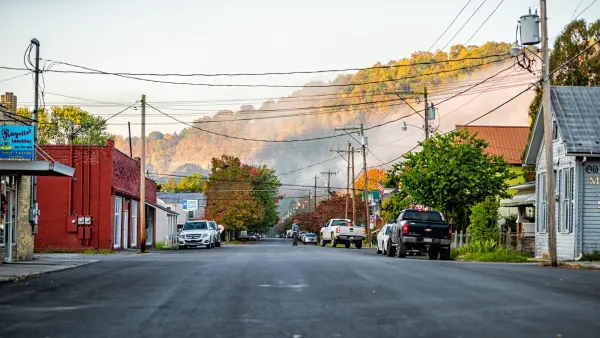
The categorization conundrum of the American exurbs
Exurban counties exemplify the shortcomings of defining rural at the county level.

Planetizen Federal Action Tracker
A weekly monitor of how Trump’s orders and actions are impacting planners and planning in America.

Eastern Nebraska is running out of electricity
Data centers and electrification are straining eastern Nebraska’s grid, throttling economic development.

Study reveals best places in the U.S. for cycling, walking
New research from Streetlight Data examines bicycle and pedestrian miles per capita in the 100 largest U.S. cities by population.

DSA members accuse Mamdani of 'abandoning values' over housing redevelopment
New York City's mayor plans to replace about 2,000 units of public housing with private, mixed-income housing.

All sides of BRT debate unhappy with CDOT’s most recent move
The Colorado Department of Transportation is no longer considering center-running bus lanes for Colorado Boulevard.

Massachusetts bogs generate both power, and cranberries
Putting solar panels above farmland is one way Massachusetts is advancing toward its goal of net-zero carbon emissions by 2050.

FREE Course: Walkable City 1: Why Walkability?
After describing his path towards focusing on walkability as the essence of good planning, Jeff Speck marches through his five principal reasons for making more walkable places.
Reinventing Malls: Planning Alchemy—Turning Gray Fields Into Gold
The course focuses on the opportunities and imperatives that shape reinvention of mall sites.

City of Rosemead
Rutgers University, Edward J. Bloustein School of Planning and Public Policy
One Hundred Miles
University of Michigan School for Environment and Sustainability (SEAS)
Hunter College, City University of New York (CUNY)
The Architects Foundation
City of Cambridge
The Pocatello Development Authority
The Urban Renewal Agency of the City of Pocatello