Proposition 13 has long been associated with California's budget woes and "fiscalization of land use" policies. Meant to apply primarily to residential property, commercial property owners have benefited more. 'Split role' could correct the problem.


"The landmark 1978 measure (known as Proposition 13) imposed a tight limit on property taxes, which previously had been the chief support for schools and local governments, and had the indirect effect of shifting much of that burden, especially for education, to the state.
"There's almost no chance that Proposition 13's limits on residential property taxes would be touched". However, a strategy known as "split roll", whereby residential and commercial property are evaluated differently, has been a longstanding favorite amongst reformers.
"One section of Proposition 13 requires taxable values to be upgraded when a parcel changes ownership. Homes almost always change hands in one sale, but business property is most often transferred incrementally, as ownership of corporations changes through stock sales. And unless more than 50 percent changes hands in one transaction, Proposition 13's reassessment provisions are not triggered.
It's still not likely to happen, but as the state's budget crisis deepens, even the politically unthinkable surfaces."
Thanks to Roundup
Read the full story: Dan Walters: Proposition 13 limits return to the agenda

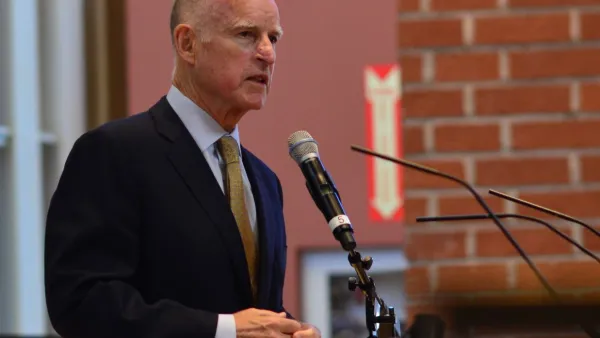
California Governor Jerry Brown Pessimistic on Affordability
Housing often costs a literal fortune in California, and Governor Jerry Brown doesn't see an easy fix. Demand to live in the state is high, but there are local factors at work impeding housing construction.
New Taxes could Drive up the Cost of Conservation in Maine
Maine trails only three states in total acreage of land protected by conservation. A new plan to end the property tax exemptions for nonprofits, however, could make that work much more difficult.
Something Good To Say About California's Prop 13 In A Housing Slump
Long considered the source of California's fiscal and land use woes, Proposition 13, passed by voters in 1978, limits increases in property tax. However, it may prove to be an 'economic stabilizer' during the current housing slump.

Planetizen Federal Action Tracker
A weekly monitor of how Trump’s orders and actions are impacting planners and planning in America.

Amtrak, CN end decades-long dispute with eight-year agreement
The new operating agreement establishes an updated framework for the companies to work together, including processes to resolve disputes.

Judges permit Denver to divert 77,000 acre feet from the Colorado River for reservoir expansion
Overuse and climate change have caused the Colorado River’s water levels to plummet.

NYC DOT wants faster, more permanent street upgrades
The city is examining ways to build more concrete infrastructure without getting entangled in 'decades-long' projects.

'Something we’ve never seen before:' rising utility rates could strain city finances nationwide
Data centers, climate change and other factors have caused utility rates in the United States to increase by 38% since 2020.

Trump to overrule local leaders, lease millions of acres of America’s Pacific Island territories’ seafloors to mining companies
International law says that the Indigenous people of America’s territories have a right to prior and informed consent regarding projects that impact their countries.

FREE Course: Walkable City 1: Why Walkability?
After describing his path towards focusing on walkability as the essence of good planning, Jeff Speck marches through his five principal reasons for making more walkable places.
Reinventing Malls: Planning Alchemy—Turning Gray Fields Into Gold
The course focuses on the opportunities and imperatives that shape reinvention of mall sites.

Harvard University Graduate School of Design
KFH Group Inc.
Greater Baltimore Committee
The Architects Foundation
University of Cincinnati Online
The Pocatello Development Authority
The Urban Renewal Agency of the City of Pocatello