Vatican City has plans to build the largest solar plant in Europe, which will supply enough power for 40,000 households in a state of 900 inhabitants.


"Advised by German solar-panel maker Solarworld AG, the Holy See is running counter to many governments that say harnessing sunlight on a grand scale is too costly to help curb global warming, especially in the deepest recession since World War II.
'Now is the time to strike,' Cardinal Giovanni Lajolo, the Vatican City's governor, said in an interview from his study overlooking the Michelangelo-designed Basilica of St. Peter's. 'One should take advantage of the crisis to try and develop these renewable-energy sources to the maximum, which in the long run will reap incomparable rewards.'
European nations, daunted by spending needed to stimulate their economies, find it hard to invest enough in clean power generation to help meet a European Union target to get an average 20 percent of energy from renewable sources by 2020.
Italy, whose Prime Minister Silvio Berlusconi threatened to play 'bad guy' in December by trying to block EU legislation to fight climate change, was given a binding target for renewable energy consumption of 17 percent. That compares with 5 percent achieved in 2005."
Read the full story: Pope Pursues Heavenly Power With Plant Harnessing Sun (Update2)
Vatican Embraces the Power of the Sun
The Vatican has announced plans to build Europe's largest solar plant to power the state.
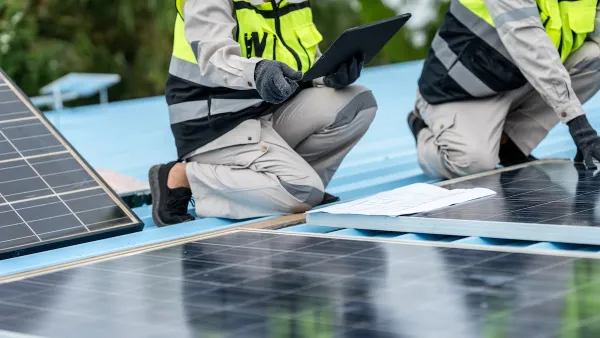
Trump administration unlawfully slashed $7 billion in clean energy grants, judge rules
The Environmental Protection Agency ended the Solar For All program, which provided the grants, after President Donald Trump’s inauguration.
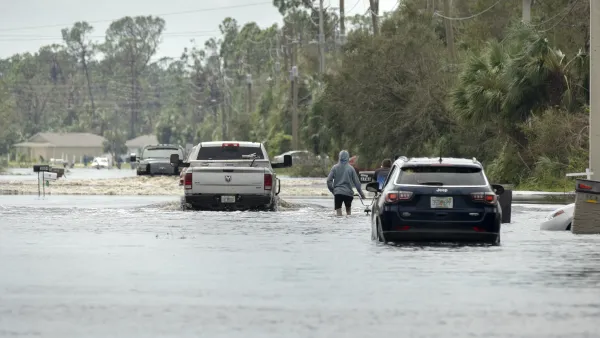
Courts order EPA to release billions in climate grants
The grants primarily funded projects aimed at Black, low-income and disadvantaged communities.

Planetizen Federal Action Tracker
A weekly monitor of how Trump’s orders and actions are impacting planners and planning in America.

California plans to bury El Niño’s downpour
If the state plays its cards right, it may be able to store a billion acre-feet of El Niño’s water in aquifers.

Desperate measures: Advocates weigh draining Lake Powell to fill Colorado River
Draining the reservoir could reduce evaporation losses by a couple hundred thousand acre-feet.

Los Angeles just elected an urban planner as its mayor
Transportation analysts are optimistic that Raman will be more aggressive in addressing transit issues than Bass.

Mamdani’s pied-à-terre tax survives legal challenge
A panel of judges found that the plaintiffs failed to demonstrate injury as a result of New York City's implementation of the tax.

Eastern Nebraska is running out of electricity
Data centers and electrification are straining eastern Nebraska’s grid, throttling economic development.

FREE Course: Walkable City 1: Why Walkability?
After describing his path towards focusing on walkability as the essence of good planning, Jeff Speck marches through his five principal reasons for making more walkable places.
Reinventing Malls: Planning Alchemy—Turning Gray Fields Into Gold
The course focuses on the opportunities and imperatives that shape reinvention of mall sites.

City of Rosemead
Rutgers University, Edward J. Bloustein School of Planning and Public Policy
One Hundred Miles
University of Michigan School for Environment and Sustainability (SEAS)
Hunter College, City University of New York (CUNY)
The Architects Foundation
City of Cambridge
Montrose County
The Pocatello Development Authority