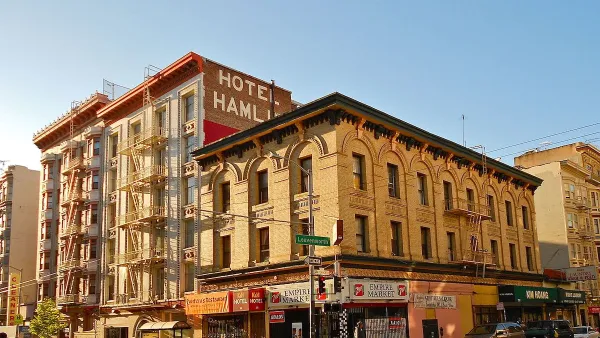
Stocked with architectural gems but fraught with crime, San Francisco's Tenderloin district has long been debated as a possible historic site. The debate is now over, as it was recently named to the National Register of Historic Places.


"...[T]he architectural richness is real, and it deserves celebration as a reminder of how complex a city can be."
"That complexity is one reason it took so long for the 33 blocks and 409 "contributing" buildings of the Uptown Tenderloin Historic District to finally be added last month to the National Register of Historic Places."
"...[T]he Tenderloin's zoning was tightened and height limits were lowered, so hotel towers no longer are a threat. Low-rent residential hotels are barred from conversion into tourist inns. The main real estate action these days is from nonprofit developers seeking to build safe housing on the underutilized sites that remain."
"Becoming one of San Francisco's 24 recognized historic districts doesn't change reality. Drug trade is persistent on some blocks. Social services targeted to the down-and-out also attract grifters looking for trouble."
"But the district absolutely deserves the honor."
Read the full story: Tenderloin's heritage wins national notice

Hundreds of San Francisco SRO Units Still Vacant
It can often take months for unhoused residents to access supportive housing. When they do, conditions can be unbearable.
Tenderloin Greenway Closer to Reality
The Golden Gate Greenway will provide much-needed permanent park and community space in the dense neighborhood.
Tenderloin National Forest
An unconventional outdoor spaces has helped transform a small part of a problem-riddled San Francisco neighborhood.

Planetizen Federal Action Tracker
A weekly monitor of how Trump’s orders and actions are impacting planners and planning in America.

California plans to bury El Niño’s downpour
If the state plays its cards right, it may be able to store a billion acre-feet of El Niño’s water in aquifers.

Chicago breaks ground on $3 billion megadevelopment
The new neighborhood, titled Foundry Park, will one day host 3,700 residences.

Satanic Place Names
From streams and lakes to valleys and canyons, I mapped more than 1,000 places named after the Devil.

California High-Speed Rail Authority CEO resigns after $600,000 scandal
Under Ian Choudri, the authority used taxpayer dollars to fund first class flights and trips to nightclubs.

Want to study the Missouri River? Soon, you may need unanimous approval from 10 states
Legislation would require 10 governors’ permission to study or build projects moving water outside the basin.

FREE Course: Walkable City 1: Why Walkability?
After describing his path towards focusing on walkability as the essence of good planning, Jeff Speck marches through his five principal reasons for making more walkable places.
Reinventing Malls: Planning Alchemy—Turning Gray Fields Into Gold
The course focuses on the opportunities and imperatives that shape reinvention of mall sites.

City of Rosemead
Rutgers University, Edward J. Bloustein School of Planning and Public Policy
One Hundred Miles
Hunter College, City University of New York (CUNY)
The Architects Foundation
University of Cincinnati Online
City of Cambridge
Montrose County
The Pocatello Development Authority