Treehugger recently heralded fuel-producing algae the hottest green technology going. GOOD Magazine takes a clear-eyed look at the promise and the pitfalls.


"Unlike many other biofuels, algae doesn't displace food crops. That's significant because one fundamental dilemma with biofuels is that they'll crush our economy with rising food costs, by competing with edible crops for arable land.
But algae aren't great multitaskers. 'Algae usually just reproduce or make oil,' says Tom Todaro, CEO of Sustainable Oils. 'They don't usually do both. Under favorable conditions they'd rather multiply than store their energy.'
So there's a dilemma: You want your algae to multiply so you have a lot of it, but if they're spending energy multiplying they won't make any oil. That's why companies such as Sustainable Oils are trying to engineer algae that balance the two imperatives, multiplying rapidly in the first few days of life, and making oil thereafter."
Read the full story: A Primer: Can Algae Replace Gasoline?

Your Next Car May Run on Alligator Fat
Wedged into a report about the merits of various alternative fuels for port activities is a recent report from the American Chemical Society stating that alligator fat may be a great alternative to soy-based biogas.
Electricity from Biomass More Efficient than Ethanol
A new study by researchers at the University of California, Merced suggests that using biomass to create electricity to power cars could be more efficient than using the same biomass to create ethanol to power cars.
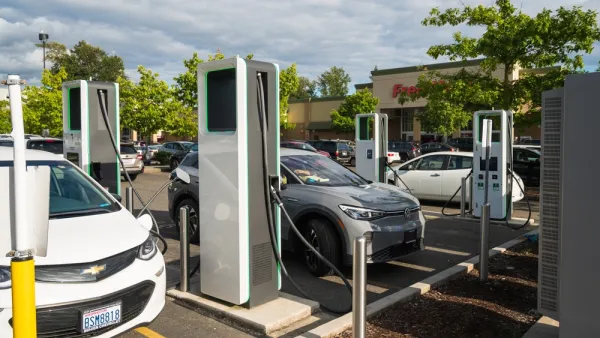
Federal Alternative Fuel Charging Grant Funding Announced
The grant program is part of the 2021 infrastructure act, which promised to invest in charging and fueling stations for electric cars and other vehicles powered by alternative energy.

Planetizen Federal Action Tracker
A weekly monitor of how Trump’s orders and actions are impacting planners and planning in America.

Amtrak, CN end decades-long dispute with eight-year agreement
The new operating agreement establishes an updated framework for the companies to work together, including processes to resolve disputes.

Judges permit Denver to divert 77,000 acre feet from the Colorado River for reservoir expansion
Overuse and climate change have caused the Colorado River’s water levels to plummet.

New density bill would require 7 California cities to establish regional transit hubs
The bill would also require major cities in California to permit high-rise residential buildings.

San Francisco supervisor looks to establish city’s first department of housing
The proposed agency would coordinate planning and financing around housing, as well as support affordable housing production.

South Chicago development proposal would 'upzone' neighborhoods to increase density
The South Chicago Land Use Framework plan also aims to promote pedestrian and transit-oriented developments.

FREE Course: Walkable City 1: Why Walkability?
After describing his path towards focusing on walkability as the essence of good planning, Jeff Speck marches through his five principal reasons for making more walkable places.
Reinventing Malls: Planning Alchemy—Turning Gray Fields Into Gold
The course focuses on the opportunities and imperatives that shape reinvention of mall sites.

City of Wisconsin Rapids
Harvard University Graduate School of Design
KFH Group Inc.
The Architects Foundation
University of Cincinnati Online
The Pocatello Development Authority
The Urban Renewal Agency of the City of Pocatello