Responding to an opinion piece that claims there is no proof that transit-oriented development works to reduce auto use and emissions, writer Eric De Place catalogs the significant body of literature that proves it.


"The best compilation on the research connecting urban form with greenhouse gas emissions is Growing Cooler, a reader-friendly volume edited by Reid Ewing. (By the way, this is an extremely well-known book in the business and it's perplexing that the authors would be unaware of it.) Another classic is the report Measuring Sprawl and Its Impact, also edited by Reid Ewing. Here's a wonderfully readable -- and recent -- summary, The Greenness of Cities, coauthored by professors from Harvard and UCLA. (Bonus: here's a blog post I wrote based on separate research from one of the authors, Matthew Kahn.) And then there's the Victoria Transport Policy Institute, where Todd Litman keeps an exhaustively cited summary of the research on transit-oriented development and its environmental and social impacts. There's also what is perhaps the magnum opus on the subject, Sustainabilty and Cities, a comprehensive look at density, driving and other topics in cities around the world by Newman & Kenworthy. If that's not enough, you might check out a longer technical review by the US EPA, as well as a boring technical report prepared by ICF International."
Read the full story: How Transit-Oriented Development Works
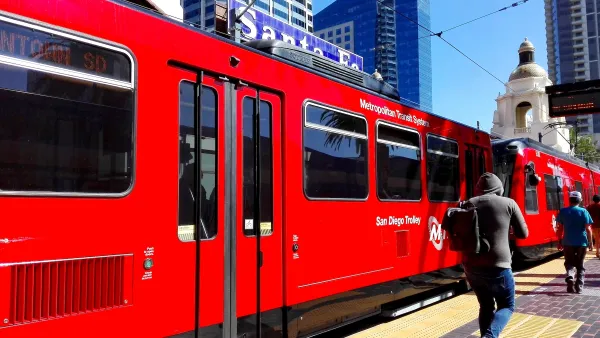
San Diego wants to limit upzoning law to just 16% of transit-adjacent parcels
The city's planning director says some areas are unfit for immediate upzoning due to a lack of resources or hazards such as wildfire risk.
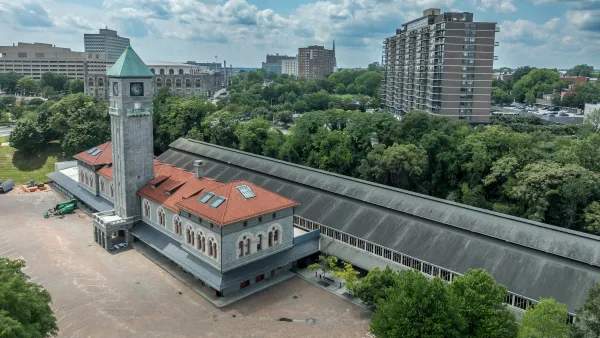
Maryland unveils plan for 5,000 homes near transit
Gov. Moore announced a plan to activate housing construction on 134 acres of state-owned land near transit stations.
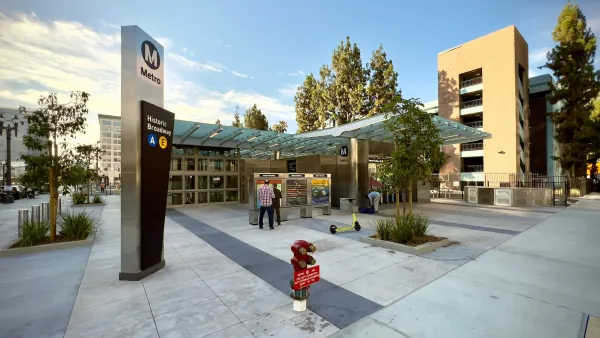
LA Delays State TOD Law to 2030 With its Own, Lower-density Plan
SB 79 allows cities to delay its implementation if they come up with alternate plans to boost density while retaining local control near transit.

Planetizen Federal Action Tracker
A weekly monitor of how Trump’s orders and actions are impacting planners and planning in America.

California plans to bury El Niño’s downpour
If the state plays its cards right, it may be able to store a billion acre-feet of El Niño’s water in aquifers.

Desperate measures: Advocates weigh draining Lake Powell to fill Colorado River
Draining the reservoir could reduce evaporation losses by a couple hundred thousand acre-feet.

US buildings threatened, destroyed by fires set to triple by 2060
Researchers found a high fire risk for socioeconomically vulnerable neighborhoods in the American West.

LA residents may be allowed to paint their own crosswalks
Councilwoman Katy Yaroslavsky put out a motion instructing the Los Angeles Department of Public Transportation to study the feasibility of allowing volunteers to paint crosswalks.

Dallas moves to overhaul its zoning code
The city's zoning reform will allow more multi-family and mixed-use developments.

FREE Course: Walkable City 1: Why Walkability?
After describing his path towards focusing on walkability as the essence of good planning, Jeff Speck marches through his five principal reasons for making more walkable places.
Reinventing Malls: Planning Alchemy—Turning Gray Fields Into Gold
The course focuses on the opportunities and imperatives that shape reinvention of mall sites.

City of Rosemead
Rutgers University, Edward J. Bloustein School of Planning and Public Policy
One Hundred Miles
Hunter College, City University of New York (CUNY)
The Architects Foundation
University of Cincinnati Online
City of Cambridge
Montrose County
The Pocatello Development Authority