This editorial argues that the San Francisco isn't ready for a complex scheme that the public dislikes, raises little funding, and would send an 'unwelcome' message to visitors.


"The Board of Supervisors will get a chance to consider the outlines of a congestion pricing proposal by April with further approvals possibly in a year.
The members should be skeptical of an idea that's drawn heavy verbal crossfire at public meetings, opposition from business and doubts about its practicality, finances and chances for success.
The pricing system is expected to raise from $30 million to $60 million per year, a relatively small amount for transit budgets. In sum, it's a concept that's loaded with uncertainties, which argues for further study and debate.
Outside a coterie of planners and hard-core enthusiasts, the notion of paying more to drive on relatively unclogged city streets isn't ready for prime time."
"Congestion pricing could strain the public support that is needed for more sensible, workable efforts to get people out of their cars.."
Read the full story: S.F.'s half-baked congestion pricing plan

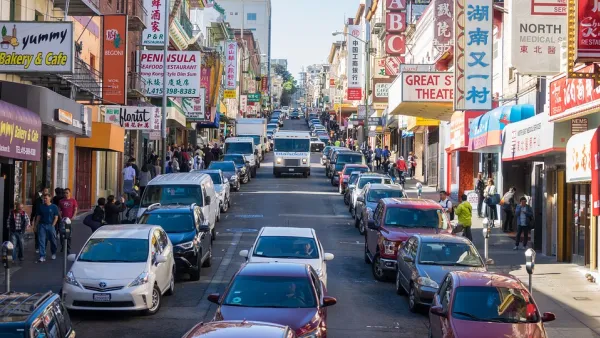
Congestion Pricing Scheme Up for Discussion in San Francisco
The public is providing feedback for the idea of a congestion pricing scheme that could charge as much as $12 to drive into Downtown San Francisco.

Congestion Pricing Has Mayoral Support in San Francisco
Additional disincentives for driving (i.e., congestion pricing and new parking fees) are on the mayor's agenda in San Francisco.
Congestion Pricing Under Discussion in San Francisco
An expanding number of major U.S. cities are exploring the idea of charging drivers to drive into certain heavily trafficked parts of town. San Francisco is the most recent to explore the idea of congestion pricing (also known as cordon pricing).

Planetizen Federal Action Tracker
A weekly monitor of how Trump’s orders and actions are impacting planners and planning in America.

Amtrak, CN end decades-long dispute with eight-year agreement
The new operating agreement establishes an updated framework for the companies to work together, including processes to resolve disputes.

Judges permit Denver to divert 77,000 acre feet from the Colorado River for reservoir expansion
Overuse and climate change have caused the Colorado River’s water levels to plummet.

New density bill would require 7 California cities to establish regional transit hubs
The bill would also require major cities in California to permit high-rise residential buildings.

San Francisco supervisor looks to establish city’s first department of housing
The proposed agency would coordinate planning and financing around housing, as well as support affordable housing production.

South Chicago development proposal would 'upzone' neighborhoods to increase density
The South Chicago Land Use Framework plan also aims to promote pedestrian and transit-oriented developments.

FREE Course: Walkable City 1: Why Walkability?
After describing his path towards focusing on walkability as the essence of good planning, Jeff Speck marches through his five principal reasons for making more walkable places.
Reinventing Malls: Planning Alchemy—Turning Gray Fields Into Gold
The course focuses on the opportunities and imperatives that shape reinvention of mall sites.

City of Wisconsin Rapids
Harvard University Graduate School of Design
KFH Group Inc.
The Architects Foundation
University of Cincinnati Online
The Pocatello Development Authority
The Urban Renewal Agency of the City of Pocatello