The city of Los Angeles has instituted an experimental program encouraging people to hail taxi cabs rather than call ahead, an effort the city hopes will create a "cab culture". This column is skeptical about how much impact the plan can have.


"The city wants to rehab our habits. Nearly six months ago, L.A. inaugurated a 'Hail a Taxi' experiment downtown and in Hollywood. It eased some restrictions on cab drivers, put up 600 "Hail a Taxi" signs and delivered some big hopeful talk of turning car culture into cab culture in parts of town with resurgent urban comings and goings, night life and restaurants and residents. Riding in cabs could cut down on traffic jams and carbon outlay, save people time and parking money and still spare us that most L.A. of indignities: having to walk."
"Could it really work, hailing a taxi in L.A.? The program fizzled in its July debut, so the city relaunched it in December. The numbers aren't in yet, but Amir Sedadi, who's the assistant general manager at the Department of Transportation, says that it's 'going a little slower than we anticipated.' You can't just pop open a can of Instant Cab Culture. It'll depend 'on both supply and demand,' on enough passengers looking for cruising cabs, and a critical mass of cabbies available for the flagging."
Read the full story: L.A.'s 'Hail a Cab' experiment
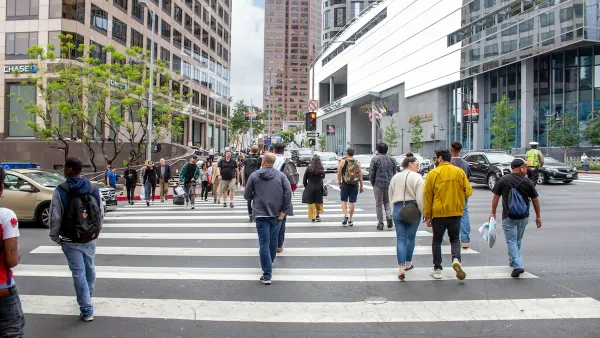
LA residents may be allowed to paint their own crosswalks
Councilwoman Katy Yaroslavsky put out a motion instructing the Los Angeles Department of Public Transportation to study the feasibility of allowing volunteers to paint crosswalks.
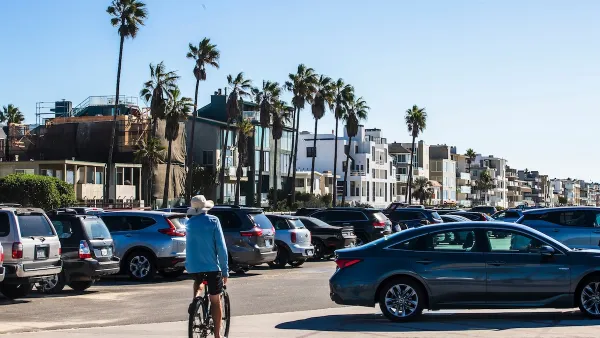
Not in my parking spot: LA renters oppose ADU development in their garages
Some tenants advocates say taking away residents’ parking spaces harms senior citizens and people with disabilities who rely on their cars to navigate the city.
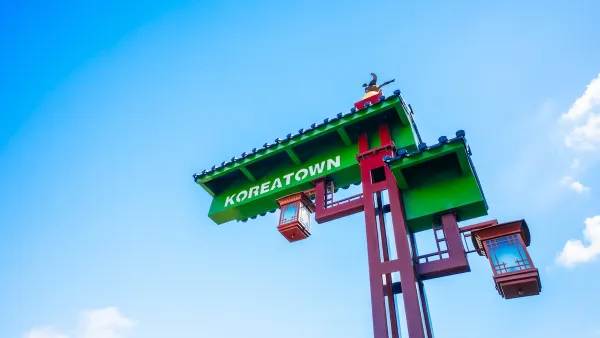
LA may place emergency ban on karaoke room permits
If Councilwoman Heather Hutt’s proposal passes, the moratorium would last between 45 days and one year.

Planetizen Federal Action Tracker
A weekly monitor of how Trump’s orders and actions are impacting planners and planning in America.

California plans to bury El Niño’s downpour
If the state plays its cards right, it may be able to store a billion acre-feet of El Niño’s water in aquifers.

Desperate measures: Advocates weigh draining Lake Powell to fill Colorado River
Draining the reservoir could reduce evaporation losses by a couple hundred thousand acre-feet.

Mamdani’s pied-à-terre tax survives legal challenge
A panel of judges found that the plaintiffs failed to demonstrate injury as a result of New York City's implementation of the tax.

Eastern Nebraska is running out of electricity
Data centers and electrification are straining eastern Nebraska’s grid, throttling economic development.

Seattle passes record-breaking transit services expansion
Proposition 1 will double the city’s transit tax to add 95,000 more bus trips and preserve 180,000 bus trips annually.

FREE Course: Walkable City 1: Why Walkability?
After describing his path towards focusing on walkability as the essence of good planning, Jeff Speck marches through his five principal reasons for making more walkable places.
Reinventing Malls: Planning Alchemy—Turning Gray Fields Into Gold
The course focuses on the opportunities and imperatives that shape reinvention of mall sites.

City of Rosemead
Rutgers University, Edward J. Bloustein School of Planning and Public Policy
One Hundred Miles
University of Michigan School for Environment and Sustainability (SEAS)
Hunter College, City University of New York (CUNY)
The Architects Foundation
City of Cambridge
Montrose County
The Pocatello Development Authority