California transportation officials are confident that federal support will back up $10 billion in recently approved bond sales to fund the state's proposed high speed rail system.


"Transportation officials say that California's high-speed rail project seems to be on a fast track to a hefty federal contribution - perhaps as much as $15 billion to $20 billion."
"That optimism in the face of a dire economic outlook is the product of the priorities of President-elect Barack Obama's administration; the likelihood of a big federal infrastructure investment; growing concern over climate change; the volatility of gas prices; Californians' backing of the $10 billion high-speed rail bond measure and strong support for the project from the state's potent congressional delegation, including Sen. Dianne Feinstein and House Speaker Nancy Pelosi."
"Building the San Francisco-to-Los Angeles and Anaheim line that will be the spine of the system will cost between $32.8 billion and $33.6 billion, according to the High Speed Rail Authority's business report. Extensions built later would cost another $12 billion. In addition to the $10 billion from state bond sales, the authority is counting on $12 billion to $16 billion in federal funds plus $6.5 billion to $7.5 billion in private investment and $2 billion to $3 billion in local contributions."
"Critics, during the campaign against state Proposition 1A, expressed skepticism about the plan's ability to attract federal funding during a recession. While most opponents now acknowledge that high-speed rail may capture billions from the new administration, they're still skeptical about the project's feasibility."
Read the full story: High-speed rail optimistic about more funding
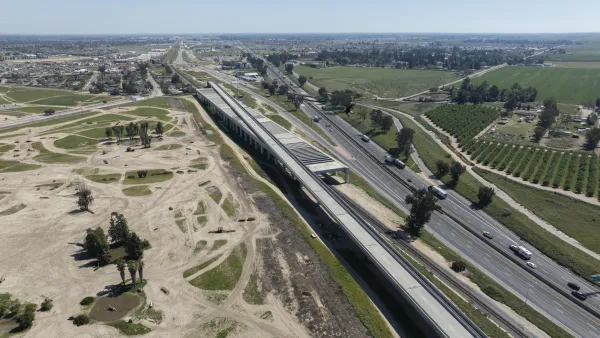
California High-Speed Rail Authority could be broke by the end of 2027
A report from the Office of Inspector General says the authority must borrow against state infusions to stay afloat.
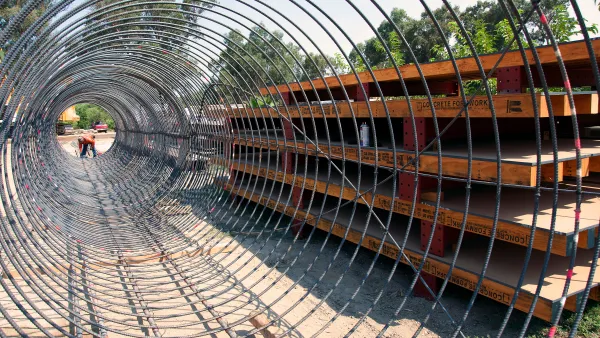
California High Speed Rail to lay first tracks
High Speed Rail Authority officials describe the milestone as "the moment this project truly begins to become a railroad."
TOD Opportunities Around America's First True High-Speed Rail Line
Brightline West hopes to break ground, in anticipation of a 2027 opening. Cities in the Inland Empire and High Desert areas of Southern California are looking to take advantage.

Desperate measures: Advocates weigh draining Lake Powell to fill Colorado River
Draining the reservoir could reduce evaporation losses by a couple hundred thousand acre-feet.

Eastern Nebraska is running out of electricity
Data centers and electrification are straining eastern Nebraska’s grid, throttling economic development.

Move over, LA: St. Louis gears up for Olympics, invests millions in downtown redevelopment
The Missouri city will host the 2028 Olympic soccer group stage and knockout matches.

Officials claim feds 'rushed' Amtrak environmental review
Amtrak plans to move their Chicago maintenance facility from an industrial area to a residential one.

NYC breaks ground on anti-flooding infrastructure project
New York City's new system will reduce stormwater flows to local sewers by 90%.

One Kentucky town’s secret to affordable housing
The Smoketown Community Land Trust has already built seven affordable homes for community members.

FREE Course: Walkable City 1: Why Walkability?
After describing his path towards focusing on walkability as the essence of good planning, Jeff Speck marches through his five principal reasons for making more walkable places.
Reinventing Malls: Planning Alchemy—Turning Gray Fields Into Gold
The course focuses on the opportunities and imperatives that shape reinvention of mall sites.

City of Rosemead
Rutgers University, Edward J. Bloustein School of Planning and Public Policy
One Hundred Miles
University of Michigan School for Environment and Sustainability (SEAS)
Hunter College, City University of New York (CUNY)
The Architects Foundation
City of Cambridge
Montrose County
The Pocatello Development Authority