As more and more of China's "floating population" return from their city jobs to their farms, officials brace for backlash from the recently unemployed.


"Fast-rising unemployment has led to an unusual series of strikes and protests. Normally cautious government officials have offered quick concessions and talk openly of their worries about social unrest. Laid-off factory workers in Dongguan overturned patrol cars and clashed with police last Tuesday, and hundreds of taxis parked in front of a government office in nearby Chaozhou over the weekend, one of a series of driver protests.
On Wednesday, workers let go from a liquor factory in northern China mounted a protest in Beijing, at the parent company's headquarters. In the latest sign of economic stress, China's currency fell Monday by its single largest margin on record against the dollar, on expectations the central bank might devalue it to prop up sagging growth.
As the government tries to calm tensions in the cities, it also fears that newly unemployed migrants returning home could upend the already-strained social system in the countryside."
Read the full story: China Fears Restive Migrants As Jobs Disappear in Cities
Is the Urban-Suburban Divide Destined to Disappear?
In a new book, Hans Westlund and Tigran Haas argue that the global knowledge economy is radically reshaping urban development. Eventually, they say, it'll render meaningless our present notions of "urban," "suburban," and "rural."
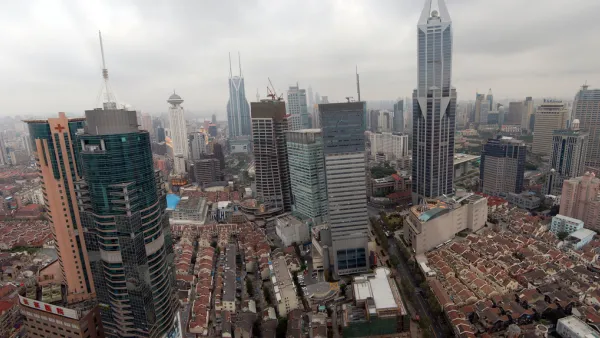
China's Megacities May Soon Rely on Urban Farming
While widespread urban farming remains pipe dream in the United States, dwindling arable land and a mass shift to cities might make it a necessity in China.
Can a "Rare Slice of California" Stave Off Sprawl?
San Luis Obispo County, along California's Central Coast, is at a crossroads. Will it go the way of Orange County and succumb to development pressures or will it follow Napa and Ventura Counties and protect its rural lands from exurban sprawl.

Washington state to charge fee to drivers with fuel-efficient cars
Revenue from the fee will go towards supporting the state’s highways.

Illinois considers spending $1 billion in taxpayer money on data center
A quantum computing campus and data center are currently under construction in Chicago.

Trump to blast ‘hydrocarbon highway’ through ‘world’s longest art gallery’
Environmental and historic preservation groups are suing to stop the project.

NYC, state sue feds over mixed-immigration-status housing assistance rule
The state’s lawsuit argues that the rule change violates the Administrative Procedure Act.

Michigan to turn neighborhood into virtual power plant
Residents will soon be able to divert their excess energy to the grid in exchange for compensation.

Data center, mining project swarm to long-awaited Alaska railroad line
The state-owned railroad approved final plans for the spur line this week; the project is expected to cost $311 million, mostly funded by the federal government

FREE Course: Walkable City 1: Why Walkability?
After describing his path towards focusing on walkability as the essence of good planning, Jeff Speck marches through his five principal reasons for making more walkable places.
Reinventing Malls: Planning Alchemy—Turning Gray Fields Into Gold
The course focuses on the opportunities and imperatives that shape reinvention of mall sites.

City of Charlotte
City of Rosemead
Rutgers University, Edward J. Bloustein School of Planning and Public Policy
University of Michigan School for Environment and Sustainability (SEAS)
Hunter College, City University of New York (CUNY)
The Architects Foundation
University District Partnership