As the federal government prepares to bail out the flailing U.S. automotive industry, it should think about changing the face of the industry from carmaker to "transportmaker", according to Robert Goodman.


"The Obama administration should ask the companies, as a condition of financial assistance, to begin shifting from being just automakers to becoming innovative 'transportmakers.' As Barack Obama's new chief of staff, Rahm Emanuel, recently said: 'You don't ever want a crisis to go to waste. It's an opportunity to do important things you would otherwise avoid.'"
"As transportmakers, the companies could produce vehicles for high-speed train and bus systems that would improve our travel options, reduce global warming, conserve energy, minimize accidents and generally improve the way we live."
"Now, the auto industry is asking for government money that promises, even with more fuel-efficient cars, to give us more of the same. Instead of supporting companies that want to put as many cars on the road as possible, we need a transformational strategy."
"As part of its loan package, the government should insist on the development of "transportmaker business plans" from the car companies, with specific timelines for developing more fuel-efficient cars. The companies should also provide detailed plans to transform some of their factories into research and manufacturing centers for the development of light-rail cars and high-speed trains and buses."
Thanks to Streetsblog
Read the full story: Have You Driven a Bus or a Train Lately?
Stimulus For Transit, Un-Stimulus For Auto Industry
Funding in the federal stimulus package for high speed rail has been cheered by transit advocates across the country. This opinion piece argues that in addition, funds should be taken away from the auto industry.
What's Good for GM...and the Nation
Michael Moore writes that the only bailout of the Big 3 automakers that makes any sense is a government takeover that re-tools the industry to build sustainable transportation modes including trains, buses, subways and light rail.
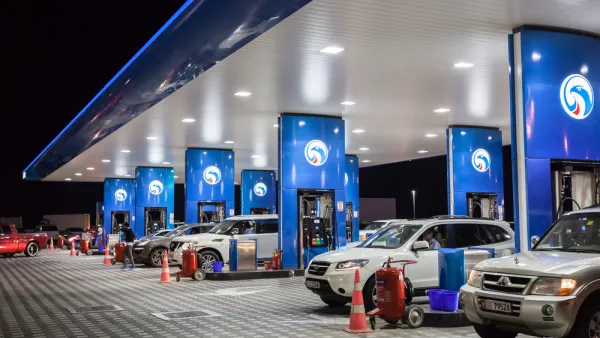
Electric Vehicle Sales Strong in 2021; SUVs Sales Still Dominate the Market
In December, data showed SUVs on course to account for more than 45% of global car sales in 2021.

Planetizen Federal Action Tracker
A weekly monitor of how Trump’s orders and actions are impacting planners and planning in America.

Eastern Nebraska is running out of electricity
Data centers and electrification are straining eastern Nebraska’s grid, throttling economic development.

Study reveals best places in the U.S. for cycling, walking
New research from Streetlight Data examines bicycle and pedestrian miles per capita in the 100 largest U.S. cities by population.

Next-generation nuclear reactors are coming to Texas
The reactors will not require towering containment structures thanks to new safety features.

California distributes $1.3 billion to prevent transit service cuts, bolster projects
Twenty-eight projects across California received a portion of the funding.

Pennsylvania Democrats have 15 affordability, clean energy bills for flipped state Senate
Bills in consideration include a bill supporting geothermal energy and a bill supporting solar on warehouses.

FREE Course: Walkable City 1: Why Walkability?
After describing his path towards focusing on walkability as the essence of good planning, Jeff Speck marches through his five principal reasons for making more walkable places.
Reinventing Malls: Planning Alchemy—Turning Gray Fields Into Gold
The course focuses on the opportunities and imperatives that shape reinvention of mall sites.

City of Charlotte
City of Rosemead
Rutgers University, Edward J. Bloustein School of Planning and Public Policy
University of Michigan School for Environment and Sustainability (SEAS)
Hunter College, City University of New York (CUNY)
The Architects Foundation
City of Cambridge
The Pocatello Development Authority
The Urban Renewal Agency of the City of Pocatello