Artist Edgar Arceneaux is the man behind the Watts Towers Project, a collaboration of international artists to make the poverty-stricken neighborhood facing on the famed folk art structure into works of art in their own right.


“What is Watts? What does Watts need? And what does Watts deserve? These have been among the hard questions Arceneaux, with the help of residents, hopes to answer. To the outside world, Watts is many things: code, a euphemism, a one-word cautionary tale. "It's a place that everybody thinks they know about but are afraid to go to," says Arceneaux. "And this project offers a chance for people to come together and build something collectively."
After dozens of community meetings, fundraisers, late-night porch talks and a trip to buy a foreclosed property at auction, this first chapter of Arceneaux's venture -- a grand-scale collaboration involving local artists and the city's major arts and educational institutions, as well as residents -- is finally beyond the drawing board phase. Based on artist Rick Lowe's Houston development, Project Row Houses, the Watts House Project (WHP) -- part conceptual art, part activism -- is a mission that Arceneaux, its director, describes as "an artwork in the shape of a neighborhood development."
At the moment, his medium looks like many old streets in L.A., those elder neighborhoods that have eluded the nip-and-tuck of assembly-line gentrification. Here stands a row of bungalows, some stucco, others with their original wood, some fronted by neat lawns, or gardens tangled with succulents or bright splashes of bottle brush."
FULL STORY: Watts House Project: art meets architecture near the Towers

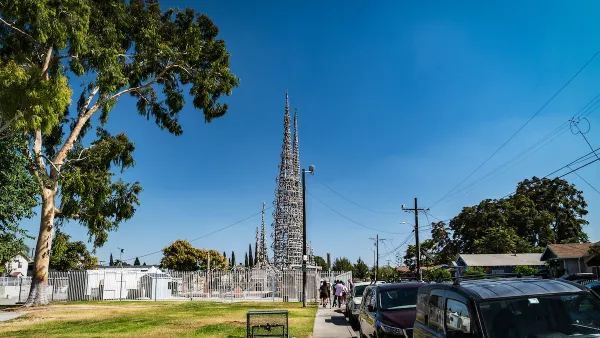
Representing Watts
Not only is JuJu Watkins restoring glory back to USC Women's Basketball, she is also proudly representing Watts where she grew up and where her family has deep roots.
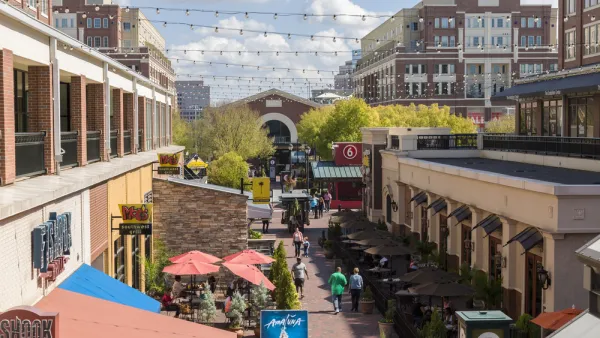
Debating Public Incentives for Private Developments
A debate common in growing cities around the country is taking place in Atlanta in answer to the question of how much support private developers need from the public.
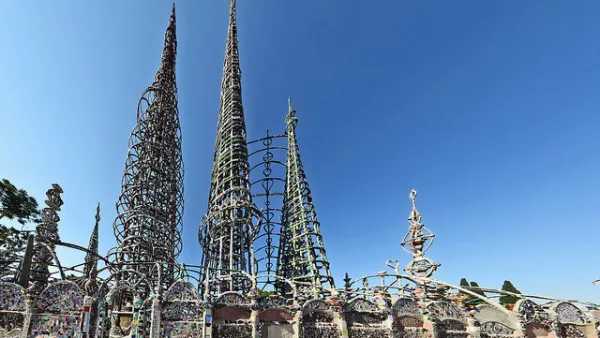
What Community-Based Zoning Enforcement Looks Like in South Central Los Angeles
Passion for urban planning, love of South Central LA communities, and historical background of the neighborhoods combine in this personal account by Jonathan P. Bell of community-based zoning enforcement.

Planetizen Federal Action Tracker
A weekly monitor of how Trump’s orders and actions are impacting planners and planning in America.

The state-sanctioned urbicide of Austin
People don’t kill cities. Freeways do.

US to reduce Colorado River water deliveries to Mexico
A new Colorado Treaty amendment reduces Mexico’s Colorado River water allocation by 250,000 acre feet.

5 New England states march closer to 800 megawatt wind energy project
Securing federal approval for the project may be complicated under the Trump administration, which has historically been hostile towards domestic wind power.

Baltimore to break ground on $50 million Transit Priority Project
The project will bring faster bus trips, safer streets and better bike connections to Baltimore.

Airbnb launches $250 million 'last-dollar financing' housing accelerator, makes first investment in Austin
The company will put $6.4 million towards affordable housing development in Texas’ capital.

FREE Course: Walkable City 1: Why Walkability?
After describing his path towards focusing on walkability as the essence of good planning, Jeff Speck marches through his five principal reasons for making more walkable places.
Reinventing Malls: Planning Alchemy—Turning Gray Fields Into Gold
The course focuses on the opportunities and imperatives that shape reinvention of mall sites.

Eagle County Government
Harvard University Graduate School of Design
Nashville Planning Department
The Architects Foundation
University of Cincinnati Online
The Pocatello Development Authority
The Urban Renewal Agency of the City of Pocatello
Journal of the American Planning Association