The next president must commit to fixing our infrastructure, says Dave Demerjian of Wired. Such an investment will create jobs, strengthen our economy and make America more competitive.


"Sens. John McCain and Barack Obama have been all but silent when it comes to repairing America's failing infrastructure, and with all that's going on in the world right now, they might be forgiven for it. They shouldn't be. Investing heavily in our infrastructure is just the thing for reinvigorating our tanking economy.
The candidates can talk all they want about shoveling money into alternative fuels, electric cars and high-speed rail, but none of that will mean much if our roads, bridges and rails can't support them. The next president must commit to fixing our infrastructure."
"'(Congress) should invest in the more than 3,000 ready-to-go highway projects that could be under contract within the next 30 to 90 days,' says John Horsley, executive director of the American Association of State Highway and Transportation Officials. 'Funding these ready to go projects offers Congress a tremendous opportunity to put Americans to work and help cash-strapped states repair and replace our crumbling infrastructure.'"
Read the full story: Note to Next President: Modern-Day WPA Will Save the Economy

The Historical Effect of Pandemics on the Economy and the Housing Market
Research into previous pandemics, like SARS in 2003, the Spanish Flu in 1918, and the early months of COVID-19 in China, offers insight into what to expect for the economy and the housing market during and after the current pandemic.
The Architecture Billings Index Was Strong on the Eve of the Pandemic
The Architecture Billings Index in February 2020 could lend hope in the current economic climate, or it could set a benchmark for a future recovery.
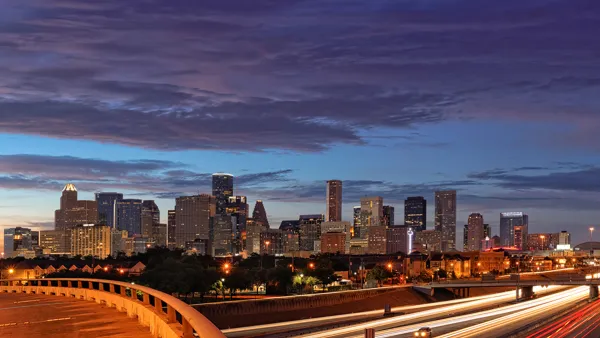
Changes in Houston Over the Last Decade
Comparing Houston in 2010 to the city today reveals a variety of transportation, infrastructure, and economic changes.

Planetizen Federal Action Tracker
A weekly monitor of how Trump’s orders and actions are impacting planners and planning in America.

Eastern Nebraska is running out of electricity
Data centers and electrification are straining eastern Nebraska’s grid, throttling economic development.

Washington state to charge fee to drivers with fuel-efficient cars
Revenue from the fee will go towards supporting the state’s highways.

Instead of building new housing, LA developers are turning mansions into mega-mansions
In the richest areas, the number of houses valued at $30 million with demolition permits has skyrocketed since 2018.

Illinois considers spending $1 billion in taxpayer money on data center
A quantum computing campus and data center are currently under construction in Chicago.

As development costs rise, Boston moves to lessen affordable housing requirements
The Boston Zoning Commission and the City Council still need to approve Boston Mayor Michelle Wu’s proposed changes

FREE Course: Walkable City 1: Why Walkability?
After describing his path towards focusing on walkability as the essence of good planning, Jeff Speck marches through his five principal reasons for making more walkable places.
Reinventing Malls: Planning Alchemy—Turning Gray Fields Into Gold
The course focuses on the opportunities and imperatives that shape reinvention of mall sites.

City of Charlotte
City of Rosemead
Rutgers University, Edward J. Bloustein School of Planning and Public Policy
University of Michigan School for Environment and Sustainability (SEAS)
Hunter College, City University of New York (CUNY)
The Architects Foundation
University District Partnership
City of Cambridge
The Pocatello Development Authority