According to Neal Payton, Santa Monica's Proposition T, intended to cut traffic growth, is useless.


"The Proposition T literature loudly proclaims, in bold type, 'Our city's own traffic consultant says we can't fit any more cars or our gridlocked streets.' How is a measure that acknowledges a problem, but then fails to provide anything resembling an adequate solution acceptable? (By the way the City uses a lot of traffic consultants, so I'd like to know which one made such an inane and unprofessional remark.)
In other words, why doesn't this measure attack the root cause of the problem, which is how people get around, to work, to shop or to play? We know that there are cities with far greater density with less traffic burdens. The reason, this measure doesn't attack the root cause, is that by doing so, the Prop-T advocates would acknowledge the value of appropriately designed mixed-use development to the long term health of the city. This measure uses the traffic as a Trojan horse to fight something more at the heart of every development issue in the city, which is what kind of City does Santa Monica want to be? Proposition T backers, would like to put a wall around this city and freeze it as is."
Read the full story: Proposition T in Santa Monica is my Candidate for the Worst Urban Planning Idea of the Year.
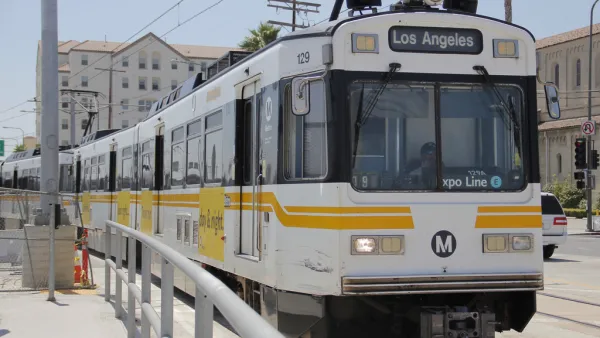
What L.A.'s New Expo Line Extension Won't Do
The $1.5 billion, 6.6-mile light rail extension from Culver City to Santa Monica is projected to double trips on the line by 2030, giving commuters a viable alternative to driving. Just the same, don't expect the extension to reduce congestion.
Which is the Real Culprit, Growth or Cars?
Jeff Wood of Reconnecting America interviewed a variety of thought leaders at the recent Congress for the New Urbanism. In this video, he talks with Jeff Tumlin about getting Santa Monica, California to embrace growth.

CA city to shut down airport, transform it into utopian park
The western side of the 200-acre park will feature a dog park, nature education center and arboretum.

Planetizen Federal Action Tracker
A weekly monitor of how Trump’s orders and actions are impacting planners and planning in America.

California plans to bury El Niño’s downpour
If the state plays its cards right, it may be able to store a billion acre-feet of El Niño’s water in aquifers.

Desperate measures: Advocates weigh draining Lake Powell to fill Colorado River
Draining the reservoir could reduce evaporation losses by a couple hundred thousand acre-feet.

Mamdani’s pied-à-terre tax survives legal challenge
A panel of judges found that the plaintiffs failed to demonstrate injury as a result of New York City's implementation of the tax.

Eastern Nebraska is running out of electricity
Data centers and electrification are straining eastern Nebraska’s grid, throttling economic development.

Seattle passes record-breaking transit services expansion
Proposition 1 will double the city’s transit tax to add 95,000 more bus trips and preserve 180,000 bus trips annually.

FREE Course: Walkable City 1: Why Walkability?
After describing his path towards focusing on walkability as the essence of good planning, Jeff Speck marches through his five principal reasons for making more walkable places.
Reinventing Malls: Planning Alchemy—Turning Gray Fields Into Gold
The course focuses on the opportunities and imperatives that shape reinvention of mall sites.

City of Rosemead
Rutgers University, Edward J. Bloustein School of Planning and Public Policy
One Hundred Miles
University of Michigan School for Environment and Sustainability (SEAS)
Hunter College, City University of New York (CUNY)
The Architects Foundation
City of Cambridge
Montrose County
The Pocatello Development Authority